Showing posts with label Dead. Show all posts

Sunday, April 1, 2012

Sixth Sunday of Lent - Entombment

Title: Entombment
Artist: Fra Angelico
Medium: Tempera on wood
Size: 38 x 46 cm
Date: 1438-40
Location: Alte Pinakothek, Munich.

John 19:41-42 - At the place where Jesus was crucified, there was a garden, and in the garden a new tomb, in which no one had ever been laid. Because it was the Jewish day of Preparation and since the tomb was nearby, they laid Jesus there.

This panel was part of the altarpiece of the main altar in the monastery church of San Marco, Florence, and was originally in the middle of its predella. Christ's body is supported by Nicodemus, and his hands are held and kissed by the stooping Virgin and St John. Christ has a weightless air about him, so that the three other figures appear to have to do little to support him. The winding cloth lies stretched out in a receding rectangle creating the foreground space, its folds and color echoing the white rock. Behind lies the dark rectangular void of the tomb. The sparsity and simplicity of the composition, the firmly closed-off space and the extensive use of white in this panel, are all also found in Angelico's frescoes at San Marco. The figures here, arranged parallel with each other, with the central perspective of the shroud leading to the tomb, shows a very different idea of spatial organization from that in Rogier van der Weyden's panel of the same subject.

Fra Angelico (c. 1395 – February 1455), was a Florentine painter as well as a Dominican friar, having entered a Dominican convent in Fiesole in 1418. He rose from obscure beginnings as a journeyman illuminator to the renown of an artist whose last major commissions were monumental fresco cycles in St Peter’s and the Vatican Palace, Rome. Within his lifetime or shortly thereafter he was also called Il Beato (the Blessed), in reference to his skills in painting religious subjects. In 1982 Pope John Paul II conferred beatification, in recognition of the holiness of his life, thereby making this title official.

Tuesday, August 2, 2011

19 IMAGES FROM THE 19th CENTURY: PART 15 - The Raising of the Daughter of Jairus

Title: The Raising of the Daughter of Jairus
Artist: Gabriel Max
Medium: Oil on Canvas
Size: 71.9 x 87.9 cm
Date: 1881
Location: The Walters Art Museum, Baltimore.

19 IMAGES FROM THE 19th CENTURY: PART 15

Luke 8:51-56 When he arrived at the house of Jairus, he did not let anyone go in with him except Peter, John and James, and the child’s father and mother. Meanwhile, all the people were wailing and mourning for her. “Stop wailing,” Jesus said. “She is not dead but asleep.” They laughed at him, knowing that she was dead. But he took her by the hand and said, “My child, get up!” Her spirit returned, and at once she stood up. Then Jesus told them to give her something to eat. Her parents were astonished, but he ordered them not to tell anyone what had happened.

The model for Christ has been identified as Joseph Mair, who played the role of the Lord in the famous Oberammergau Passion Play, and the artist’s first wife, Emma Kitzinger, is thought to have posed for the daughter of Jairus. Although favoring the dark tones of his teacher Karl Theodor von Piloty, Max shows his own tendency to add light, delicate tones where applicable. Here, the daughter of Jairus glows with a renewed life, as though the power of Jesus has flowed from his darkened figure, and poured into her. Her expression appears almost bewildered as she rises up from her resting place.

Gabriel Cornelius Ritter von Max (August 1840 – November 1915) was born in Prague, then part of the Austro-Hungarian Empire. He studied between 1855 and 1858 at the Prague Academy of Arts with Eduard von Engerth. From 1863 to 1867 he studied at the Munich Academy with Karl Theodor von Piloty, and also Hans Makart and Franz Defregger. His first critical success was in 1867 with the painting "Martyr at the Cross": that painting transformed the dark palette of Piloty into a religious-mystical symbolism using a psychological rendering of its subject. He continued to use the dark palette of the Piloty school well into the 1870s, later moving toward a more muted palette, using fewer, clearer colors.

Monday, August 1, 2011

19 IMAGES FROM THE 19th CENTURY: PART 14 - Sleeping Lazarus

Title: Sleeping Lazarus
Artist: Franciszek Zmurko
Medium: Oil on Canvas
Size: tbd.
Date: 1877
Location: Private Collection.

19 IMAGES FROM THE 19th CENTURY: PART 14

John 11:38-44 Jesus, once more deeply moved, came to the tomb. It was a cave with a stone laid across the entrance. “Take away the stone,” he said. “But, Lord,” said Martha, the sister of the dead man, “by this time there is a bad odor, for he has been there four days.” Then Jesus said, “Did I not tell you that if you believe, you will see the glory of God?” So they took away the stone. Then Jesus looked up and said, “Father, I thank you that you have heard me. I knew that you always hear me, but I said this for the benefit of the people standing here, that they may believe that you sent me.” When he had said this, Jesus called in a loud voice, “Lazarus, come out!” The dead man came out, his hands and feet wrapped with strips of linen, and a cloth around his face. Jesus said to them, “Take off the grave clothes and let him go.”

Zmurko depicts Lazarus is in the tomb, but the light shining on his body suggests that the stone blocking its entrance has been partially pulled away. He is unconscious, perhaps still dead, but he also seems to be listening. Does he hear the voice of Jesus, calling his name? Zmurko specialized in paintings in which the subject seemed half-awake, half-asleep. The person in this painting, Lazarus, is not bothered by thoughts, but rests in an unconscious state. His muscles are shrunken in death but his face has a look of utter peace - and why not? He has led a good life and been a friend of Jesus - could he ask for more?

Franciszek Zmurko (July 1859 – October 1910) was a Polish painter. Zmurko began drawing lessons as a young boy in his hometown with the painter Franciszek Tepa. As an adolescent he moved to Krakow to study at the Academy of Fine Arts where he had lessons from Jan Matejko. In 1877 Zmurko moved to Vienna, Austria where he was accepted at the Vienna Academy, but left soon thereafter to study under Aleksander Wagner in Munich. Zmurko returned to Krakow in 1880 and then moved to Warsaw in 1882 where he remained until his death in 1910.

Thursday, August 19, 2010

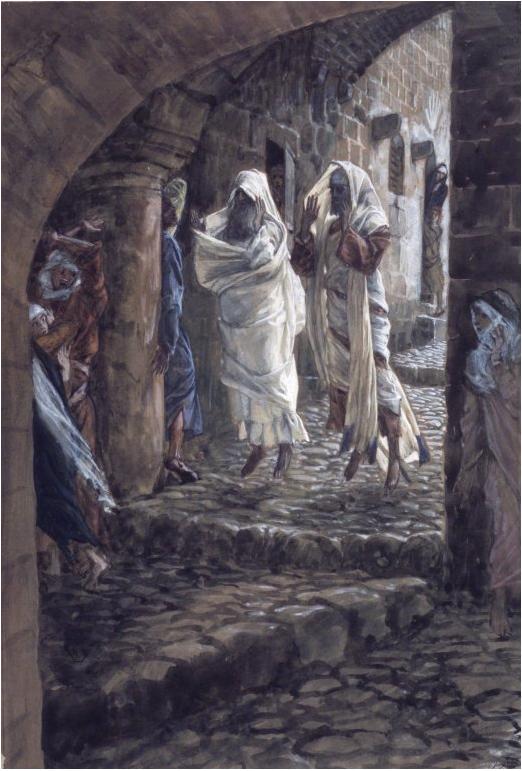
The Dead Appear in Jerusalem

Title: The Dead Appear in Jerusalem

Artist: James Tissot

Medium: Opaque watercolor over graphite on gray wove paper

Size: 27.6 x 19 cm

Date: c. 1890

Location: Brooklyn Museum, Brooklyn, New York.


Matthew 27:50-54: And when Jesus had cried out again in a loud voice, he gave up his spirit. At that moment the curtain of the temple was torn in two from top to bottom. The earth shook and the rocks split. The tombs broke open and the bodies of many holy people who had died were raised to life. They came out of the tombs, and after Jesus' resurrection they went into the holy city and appeared to many people. When the centurion and those with him who were guarding Jesus saw the earthquake and all that had happened, they were terrified, and exclaimed, "Surely he was the Son of God!"


To both pagan and Jewish audiences these signs would indicate divine approval of Jesus and disapproval of his executioners. The raising of dead persons at Jesus' death reminds us that by refusing to save himself, Jesus did save others. Yet by mentioning only “many” of the saints, Matthew clearly intends this sign merely to prefigure the final resurrection, proleptically signified in Jesus' death and resurrection


James Jacques Joseph Tissot (October 15, 1836 – August 8, 1902) was a French painter. To the surprise of all his friends, he suddenly found religion in his late 40s and decided to tell the story of Christ's passion in 350 illustrations. He conceived them not only in the realist style, but in the Orientalist idiom of Gérôme and Fromentin. The guiding intellectual force behind the images was Ernest Renan, whose "Vie de Jésus" (1863), one of the most influential books of the 19th century, who undertook to track down "the historical Jesus." The point of Tissot's watercolors was not to diminish Christ, as critics alleged, but rather to make him acceptable to that part of contemporary culture that could no longer accept Christ through the gauze of scriptural authority, that had to see him face to face.

Wednesday, August 18, 2010

The Trinity with the Dead Christ

Title: The Trinity with the Dead Christ

Artist: Ludovico Carracci

Medium: Oil on canvas

Size: 173 x 127 cm

Date: c. 1590

Location: Pinacoteca, Vatican.


According to the Trinity doctrine, God exists as three persons, or hypostases, but is one single divine nature. Some faiths profess that, in addition, the second person of the Trinity — God the Son — assumed human nature as Jesus, so that he has two natures (and hence two wills), and is really and fully both true God and true human. As stated in the Chalcedonian Creed: “truly God and truly man, of a rational soul and body”.


In this painting Lodovico managed to express the transcendent in terms of great intimacy and sincere humanity, qualities that were to be indispensable in the formation of artists such as the young Guercino. The subject, very unusual at the time of the Counter-Reformation, goes back to a purely medieval iconographic idea. Instead of the traditional, hierarchical representation of the Trinity, Lodovico combines this theme with a scene of the Pieta, in which Christ is received into the Father's arms rather than those of the Virgin.


Ludovico (or Lodovico) Carracci (April 1555 – November 1619) was an Italian, early-Baroque painter, etcher, and printmaker born in Bologna. The Carracci was a family of Bolognese painters, the brothers Agostino (1557-1602) and Annibale (1560-1609) were cousins of Lodovico, and were prominent figures at the end of the 16th century in the movement against the prevailing Mannerist artificiality of Italian painting. Lodovico was by temperament a fairly shy person who never found real success, unlike his cousin Annibale. Lodovico left Bologna only for brief periods and directed the Carracci academy by himself after his cousins left for Rome. His work, at its best, is highly personal and has a passionate and poetic quality.

Friday, August 13, 2010

Miracle at Nain

Title: Miracle at Nain

Artist: Mario Minniti

Medium: Oil on canvas

Size: 245 x 320 cm

Date: c 1620

Location: The Regional Museum of Messina, Sicily.


Luke 7:11-17: Soon afterward, Jesus went to a town called Nain, and his disciples and a large crowd went along with him. As he approached the town gate, a dead person was being carried out — the only son of his mother, and she was a widow. And a large crowd from the town was with her. When the Lord saw her, his heart went out to her and he said, "Don't cry." Then he went up and touched the coffin, and those carrying it stood still. He said, "Young man, I say to you, get up!" The dead man sat up and began to talk, and Jesus gave him back to his mother. They were all filled with awe and praised God. "A great prophet has appeared among us," they said. "God has come to help his people." This news about Jesus spread throughout Judea and the surrounding country.


The widow weeps for the loss of her only child. She is now all alone in a hostile world; no family to care for her. Recognizing her intense pain, Jesus approaches the corpse on the plank. He touches the plank--an act that would render him ceremonially unclean, but that pictures his compassion. He tells the corpse to rise up. If there were no authority behind his words, the action would be blackly humorous or tragically misguided. But Jesus reveals the extent of his authority by confronting death.


This work identifies several characteristics of Minniti’s style as dense and rapid brushstrokes, the yield of the flesh, the choice of warm brown hues lit here and there by red and ocher. If the figure of Christ with outstretched arm to the boy remembers the position and gesture of the same subject painted by Caravaggio in Resurrection of Lazarus, it takes a different approach in the enveloping background which, although idealized, may contain a reference to the real landscape visible in Messina. In the painting, full of humor and enlivened by the late Mannerist Venetian tonality, we capture that special references to local artistic climate that between the second and third decade of the seventeenth century reflected in a more sedate turn-of-the-century naturalism.


Mario Minniti (December 1577 – November 1640) was an Italian artist active in Sicily after 1606. Very little is known of Minniti’s childhood, family life or education. His movements are better recorded after 1593, when, at the age of fifteen, he moved to Rome, following the death of his father. There he became the friend, collaborator and model of the Baroque painter Caravaggio. His main fame today is his identification, or proposed identification, as a model in many of Caravaggio's early works.

Wednesday, August 11, 2010

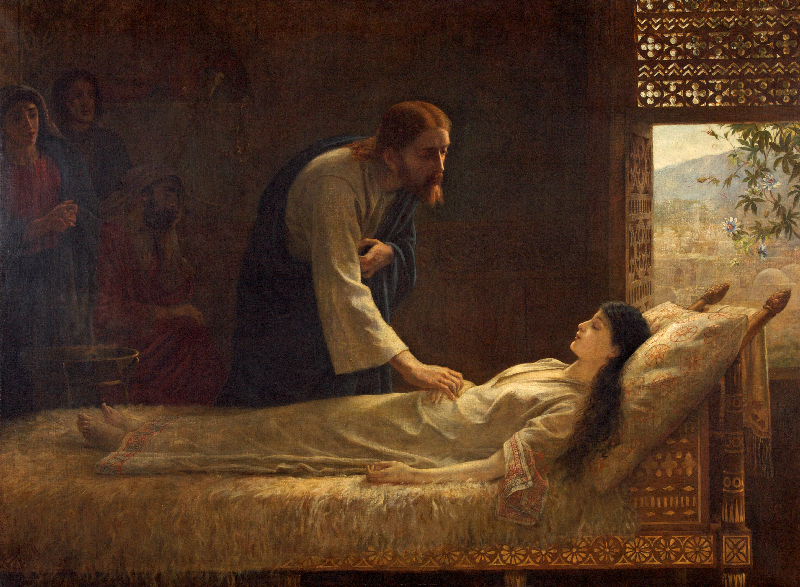
The Raising of Jairus' Daughter

Title: The Raising of Jairus' Daughter

Artist: Edwin Longsden Long

Medium: oil on canvas

Size: 163 x 183 cm

Date: 1889

Location: Victoria Art Gallery, Bath.


Mark 5:35-43: While Jesus was still speaking, some men came from the house of Jairus, the synagogue ruler. "Your daughter is dead," they said. "Why bother the teacher any more?" Ignoring what they said, Jesus told the synagogue ruler, "Don't be afraid; just believe." He did not let anyone follow him except Peter, James and John the brother of James. When they came to the home of the synagogue ruler, Jesus saw a commotion, with people crying and wailing loudly. He went in and said to them, "Why all this commotion and wailing? The child is not dead but asleep." But they laughed at him. After he put them all out, he took the child's father and mother and the disciples who were with him, and went in where the child was. He took her by the hand and said to her, "Talitha koum!" (which means, "Little girl, I say to you, get up!" ). Immediately the girl stood up and walked around (she was twelve years old). At this they were completely astonished. He gave strict orders not to let anyone know about this, and told them to give her something to eat.


The artist shows the most dramatic of moment of this passage, just before the girl comes back to life. Her parents and a disciple watch with anticipation as the miracle takes place. Jesus had sent the faithless outside, put them out, keeping only those who believed with him in the room. The window to the right of the picture, with a view of the city of Nazareth, is the primary source of light within the scene. But the reflection off the face of Jesus, most notably the illumination provided on his mouth and beard, make it seem as though the words ‘Talitha koum” are also a source of light.


Edwin Long (12 July 1829 – 15 May 1891) was an English genre, history, and portrait painter, born at Kelston, near Bath. After working locally as a portrait painter, he moved to London in the 1850s and became a very successful artist, painting Middle Eastern scenes populated with beautiful young women. Long was elected an associate of the Royal Academy in 1870 and an academician (RA) in 1881. Although he only painted a few Biblical pictures, religion was very important to Long. His parents had given him a religious upbringing; they were Congregationalist Dissenters and attended chapel regularly. Long never forgot his place of birth: in the 1880s he moved into an imposing house which he called Kelston.

Monday, August 9, 2010

Raising of Lazarus

Title: Raising of Lazarus

Artist: Michelangelo Merisi da Caravaggio

Medium: oil on canvas

Size: 380 x 275 cm

Date: 1608-09

Location: Museo Nazionale, Messina.


John 11:38-44: Jesus, once more deeply moved, came to the tomb. It was a cave with a stone laid across the entrance. "Take away the stone," he said. "But, Lord," said Martha, the sister of the dead man, "by this time there is a bad odor, for he has been there four days." Then Jesus said, "Did I not tell you that if you believed, you would see the glory of God?" So they took away the stone. Then Jesus looked up and said, "Father, I thank you that you have heard me. I knew that you always hear me, but I said this for the benefit of the people standing here, that they may believe that you sent me." When he had said this, Jesus called in a loud voice, "Lazarus, come out!" The dead man came out, his hands and feet wrapped with strips of linen, and a cloth around his face. Jesus said to them, "Take off the grave clothes and let him go."


Lazarus was the patron of the wealthy Genoese merchant Giovanni Battista de' Lazzari, to whom Caravaggio was contracted to paint an altarpiece in the church of the Padri Crociferi for a fee of a thousand scudi, more than double any Caravaggio had received previously. Most of Caravaggio's religious subjects emphasize sadness, suffering and death. But in this painting he dealt with the triumph of life, and in doing so created the most visionary picture of his career.


As in several paintings from this period of Caravaggio's career, he has set the scene against blank walls that overwhelm the actors, who are laid out like figures on a frieze. As is usual with Caravaggio, light becomes an important element in the drama, picking out crucial details such as Lazarus's hands - one lax and open to receive, the other reaching towards Christ - and the wonder-struck faces of the onlookers. Some of these people may have been modeled on members of the community, but at this stage Caravaggio did not have time to base himself wholly on models and relied on his memory - the whole design is based on an engraving after Giulio Romano, and his Jesus is a reversed image of the Christ who called Matthew to join him. There is a remarkable contrast between the flexible bodies of the grieving sisters and the near-rigid corpse of their brother. Jesus is the resurrection and the life and in the darkness through him the truth is revealed.


Michelangelo Merisi da Caravaggio, (1571, Caravaggio - 1610, Porto Ercole) was an Italian artist active between 1593 and 1610. He was the first great representative of the Baroque school of painting, noted for his intensely emotional canvases and dramatic use of lighting. The Resurrection of Lazarus was created during a period when Caravaggio was on the run, having fled authorities in Rome after a violent incident in 1606. The works of Caravaggio's flight, painted under the most adverse of circumstances, show a subdued tone and a delicacy of emotion that is even more intense than the overt dramatics of his earlier paintings. Famous and extremely influential while he lived, Caravaggio was almost entirely forgotten in the centuries after his death. Only in the 20th century was his importance to the development of Western art rediscovered.

Wednesday, March 24, 2010

The Entombment of Christ

Title: The Entombment of Christ

Artist: Sisto Badalocchio

Medium: Oil on canvas

Size: tbd.

Date: 1610

Location: Galleria Borghese, Rome.


Mark 15:46-47 and placed it in a tomb cut out of rock. Then he rolled a stone against the entrance of the tomb. Mary Magdalene and Mary the mother of Joses saw where he was laid.


Though no direct participation in the preparation of Christ’s body by the women is mentioned in the Gospel, Mark still stresses the importance of their knowledge about those events. They are not participants, but rather witnesses.


This important painting, ‘The Entombment of Christ’, dating from the first decade of the 17th century, is attributed to Sisto Badalocchio. Here human participation in the event has become the main focus. A comparison with Raphael's Deposition (also in the Galleria Borghese), which inspired it, reveals how the painter insisted on the emotions as reflected in natural movements, and was influenced both by Dürer's prints and antique sculpture.


Sisto Badalocchio Rosa (c.1581 - c.1647) was an Italian painter and engraver of the Bolognese School. Born in Parma, he worked first under Agostino Carracci in Bologna, then Annibale Carracci, in Rome. Annibale's death in 1609 precipitated Badalocchio's return to Emilia. There in 1613 he created his most important work, the frescoes in the cupola and pendentives of San Giovanni Evangelista, Reggio Emilia, a reinterpretation of Correggio's work in the church of the same name in Parma.

Wednesday, March 17, 2010

Crucifixion

Title: Crucifixion

Artist: Giotto di Bondone

Medium: Fresco

Size: 180 x 210 cm

Date: 1310s

Location: North transept, Lower Church, San Francesco, Assisi.


Mark 15:37-38 With a loud cry, Jesus breathed his last.


The curtain of the temple was torn in two from top to bottom.


The curtain of the temple separated the holiest part of the temple sanctuary from the rest of the sanctuary. This Holiest of Holies was understood to be the particular place of God’s presence. To say the curtain had been torn was to affirm that the execution of Jesus means that access to the presence of God is now open.


Giotto di Bondone (c.1267 – January 8, 1337), better known simply as Giotto, was an Italian painter and architect from Florence in the late Middle Ages. He is generally considered the first in a line of great artists who contributed to the Italian Renaissance. In 1287, at the age of about 20, Giotto married Ricevuta di Lapo del Pela, known as "Ciuta". The couple had numerous children, (perhaps as many as eight) one of whom, Francesco, became a painter. From 1306 to 1311 Giotto was in Assisi, where he painted frescoes in the north transept area of the Lower Church, including The Life of Christ and various miracles by St Francis. The direct authorship of Giotto is debated, and many of these scenes were probably executed by Giotto's workshop under the direction of the master.

Saturday, September 12, 2009

Descent into Hell

Title: Descent into Hell

Artist: Nicholas Roerich

Medium: Tempera on canvas

Size: 61 x 50 cm

Date: 1933

Location: State Museum of Oriental Art, Moscow.


The Harrowing of Hell is a doctrine in Christian theology referenced in the Apostles' Creed, which states that Jesus "descended into Hell". For example, the Catechism of the Catholic Church states: "The frequent New Testament affirmations that Jesus was "raised from the dead" presuppose that the crucified one sojourned in the realm of the dead prior to his resurrection. This was the first meaning given in the apostolic preaching to Christ's descent into hell: that Jesus, like all men, experienced death and in his soul joined the others in the realm of the dead. But he descended there as Savior, proclaiming the Good News to the spirits imprisoned there.”


Here, in the place of devils, Roerich uses deep sea angler fish, a recently discovered demonic denizen of the deep. This change adds further to the sensation hat Christ is descending into some alien world, familiar yet strange, as the color shifts between hot orange and cold blue tones. Roerich depicts Christ as he is most alone, before he has reached the souls who had passed before him and becomes their way to the Kingdom of Heaven. Christ’s descent into hell entails experiencing the fullness of alienation, sin and death, which he then absorbs, transfigures, and defeats through the Resurrection.


Nicholas Roerich, (October 9, 1874 - December 13, 1947) also known as Nikolai Konstantinovich Rerikh (alternative transliteration), was a Russian painter, philosopher, scientist, writer, traveler, public figure. He created about 7000 paintings (many of them are exhibited in well-known museums of the world) and about 30 literary works. Roerich was an initiator of International Pact for protection of artistic and academic institutions and historical sites, and a founder of international movement for culture defense. Roerich earned several nominations for the Nobel Prize for his work to preserve cultural artifacts.

Friday, September 4, 2009

The Lamentation over the Dead Christ

Title: The Lamentation over the Dead Christ

Artist: Andrea Mantegna

Medium: Tempera on canvas

Size: 68 x 81 cm

Date: c. 1490

Location: Pinacoteca di Brera, Milan.


The dating of this painting is debated, there are several assumptions ranging from the end of the Paduan period of the artist (c. 1457) to 1501. This painting may have been intended for the artist’s own funeral, and, in fact, it was shown at the head of his catafalque when he died. The most remarkable aspect of the painting is the perspective construction whereby the image of Christ appears to "follow" the spectator around the room through the use of an illusionistic technique.


The simple window-like framing of the confined space in this painting architecturally defines it as the cold and dismal cell of a morgue. Looking in we see an almost monstrous spectacle: a heavy corpse, seemingly swollen by the exaggerated foreshortening. The faces are seamed by wrinkles, which harmonize with the watery satin of the pinkish pillow, the pale granulations of the marble slab and the veined onyx of the ointment jar. The damp folds of the shroud emphasize the folds in the tight skin, which is like torn parchment around the dry wounds. Mantegna's creative power lies in his own interpretation of the historic, his feeling for spectacle on a small as well as a large scale. He has a tragic sense of the history and destiny of man, and of the problems of good and evil, life and death.


Andrea Mantegna (c. 1431 – September 13, 1506) was a Venetian Renaissance artist, and a student of Roman archeology. Mantegna experimented with perspective in order to create a sense of greater monumentality. His flinty, metallic landscapes and somewhat stony figures give evidence of a fundamentally sculptural approach to painting. One of the key artistic figures of the second half of the 15th century, Mantegna was the dominant influence on north Italian painting for 50 years. It was also through him that German artists, notably Albrecht Dürer, were made aware of the artistic discoveries of the Italian Renaissance.