Showing posts with label England. Show all posts

Thursday, October 25, 2012

A Month of Miracles Part 19 - Healing of the Lunatic Boy

Title: The Healing of the Lunatic Boy
Artist: John Reilly
Medium: Oil on canvas
Size: 66.5 x 106 cm
Date: 1958
Location: Oxford Brookes University


Matthew 17:14-18 - When they came to the crowd, a man approached Jesus and knelt before him. “Lord, have mercy on my son,” he said. “He has seizures and is suffering greatly. He often falls into the fire or into the water. I brought him to your disciples, but they could not heal him.” Jesus replied, “You unbelieving and perverse generation, how long shall I stay with you? How long shall I put up with you? Bring the boy here to me.” Jesus rebuked the demon, and it came out of the boy, and he was healed at that moment.

Here Reilly has given us an image of 'before' and 'after' with yellow almost the home key, we see the child in his right mind together with Jesus on the left brightly shining after the moment of healing. Its antithesis, on the right, the blue-grey, appears slightly violet because of the way our eyes react to very strong statements of color. There we see the darkened experience of the before, of the distressed boy and his parents. Vertical and horizontal lines divide the space into definite areas which act in counterpoint to the more fluent lines of the figures. It seems as if the figures are in danger of becoming caricature. But Reilly has concentrated on the humanity of all involved, and the bold color serves to reinforce the emotion of the scenes.

John Reilly (1928- ) is a contemporary English painter who has works in such notable galleries as the Methodist Church Collection, Isle of Wight Council Heritage, and The John Wesley’s House Museum of Methodism.

Sunday, October 14, 2012

A Month of Miracles Part 8 - Healing of Two Demon Possessed Men

Title: The Healing of Two Demon Possessed Men
Artist: Brian J. Turner
Medium: Acrylic on board      
Size: 10.2 x 7.6 cm 
Date: 2007
Location: Private collection


Matthew 8:28-34 - When He had come to the other side, to the region of the Gadarenes, two demon-possessed men met Him as they came out of the tombs. They were so violent that no one could pass that way. Suddenly they shouted, “What do You have to do with us, Son of God? Have You come here to torment us before the time?” Now a long way off from them, a large herd of pigs was feeding. “If You drive us out, send us into the herd of pigs.” the demons begged Him. “Go!” He told them. So when they had come out, they entered the pigs. And suddenly the whole herd rushed down the steep bank into the sea and perished in the water. Then the men who tended them fled. They went into the city and reported everything—especially what had happened to those who were demon-possessed. At that, the whole town went out to meet Jesus. When they saw Him, they begged Him to leave their region.

The demons have an apparently legitimate complaint; it is not yet “the time,” - the Day of Judgment. But Jesus is present and is already breaking the powers of darkness. Jesus permitting the demons to enter the pigs is, again, perhaps because the true Day of Judgment had not yet arrived.
 
Brian J. Turner is a contemporary English painter, whose stated ambition is to paint his way through the Bible. Turner completed a one year Foundation course in Fine Art at Hertfordshire College of Art & Design in 1974, before moving to Exeter to undertake his B.A.(Hons) Fine Art Degree, graduating in 1978. On his website his current project is planned to unfold over the next twenty years. Viewers who browse this site are invited to spend time with the paintings - variously narrative and abstract - as they appear online, and as one route to spiritual growth and understanding faith

Wednesday, August 3, 2011

19 IMAGES FROM THE 19th CENTURY: PART 16 - The Miracle of the Gaderene Swine

Title: The Miracle of the Gaderene Swine
Artist: Briton Riviere
Medium: Oil on Canvas
Size: 107.9 x 160.7 cm
Date: 1883
Location: Tate Gallery, London.

19 IMAGES FROM THE 19th CENTURY: PART 16

Mark 5:1-20 They went across the lake to the region of the Gaderene. When Jesus got out of the boat, a man with an impure spirit came from the tombs to meet him. This man lived in the tombs, and no one could bind him anymore, not even with a chain. For he had often been chained hand and foot, but he tore the chains apart and broke the irons on his feet. No one was strong enough to subdue him. Night and day among the tombs and in the hills he would cry out and cut himself with stones. When he saw Jesus from a distance, he ran and fell on his knees in front of him. He shouted at the top of his voice, “What do you want with me, Jesus, Son of the Most High God? In God’s name don’t torture me!” For Jesus had said to him, “Come out of this man, you impure spirit!” Then Jesus asked him, “What is your name?” He replied, “My name is Legion, for we are many.” And he begged Jesus again and again not to send them out of the area. A large herd of pigs was feeding on the nearby hillside. The demons begged Jesus, “Send us among the pigs; allow us to go into them.” He gave them permission, and the impure spirits came out and went into the pigs. The herd, about two thousand in number, rushed down the steep bank into the lake and were drowned. Those tending the pigs ran off and reported this in the town and countryside, and the people went out to see what had happened. When they came to Jesus, they saw the man who had been possessed by the legion of demons, sitting there, dressed and in his right mind; and they were afraid. Those who had seen it told the people what had happened to the demon-possessed man—and told about the pigs as well. Then the people began to plead with Jesus to leave their region. As Jesus was getting into the boat, the man who had been demon-possessed begged to go with him. Jesus did not let him, but said, “Go home to your own people and tell them how much the Lord has done for you, and how he has had mercy on you.” So the man went away and began to tell in the Decapolis how much Jesus had done for him. And all the people were amazed.

Jesus' request for the name of the demon brings the response Legion, a reference to a unit made up of thousands of soldiers. No doubt the name indicates the extent of the possession and the difficulty of Jesus' task in dealing with it. But the demons feared Jesus, feared being sent away, so they asked to be allowed to inhabit the swine on a nearby hill. The choice of pigs is interesting, given their association with uncleanliness in the Old Testament (Lev 11:7). It is not clear why the demons made such a request, other than to escape judgment. The demons' request is granted, but their relief is short-lived. The pigs apparently are startled and rush headlong over a cliff and into the sea. In Judaism the sea was a symbol of potential evil, so this becomes an illustration of evil's destructiveness. When the people travel out to the scene of the miracle, they see a transformed man sitting at Jesus' feet dressed and in his right mind. The people's reaction is instructive; for some people it is very difficult to let God and his power get close to them. These people recognized that Jesus had power, and it aroused fear in them, and they chose to have nothing to do with it. Jesus possesses authority so great that he can reverse the effects of evil. Some are transformed by that power--turned from a path of uncleanliness, destruction and death to life and testimony. But others fear it and want God's presence to be distant from them. They fear what involvement with God's power might entail.

Briton Riviere (1840-1920) was an Irish artist born in London, England. The son of an artistic father, he gave early promise of distinction in the realm of art. At the age of eighteen he exhibited three works at the Royal Academy, and by 1863 that he became a regular contributor to the Academy exhibitions. In that year he was represented by "The Eve of the Spanish Armada", and in 1864 by a "Romeo and Juliet". Subjects of this kind did not, however, attract him long, for in 1865 he began, with a picture of a "Sleeping Deer-hound", a series of paintings of animal-subjects which later occupied him almost exclusively. Even in this branch of art he has successfully introduced the religious element, as may be seen in The Miracle of the Gaderene Swine and his popular painting of Daniel in the lion’s den, Daniel's Answer to the King, housed in the Walker Art Gallery.

Wednesday, July 27, 2011

19 IMAGES FROM THE 19th CENTURY: PART 9 - The Wise and Foolish Virgins

Title: The Wise and Foolish Virgins
Artist: Sir Edward Coley Burne-Jones
Medium: Pen and ink and grey wash, with scratching out.
Size: 45.8 x 60.5 cm
Date: 1859
Location: Private collection.

19 IMAGES FROM THE 19th CENTURY: PART 9

Matthew 25:1-13 “... the kingdom of heaven will be like ten virgins who took their lamps and went out to meet the bridegroom. Five of them were foolish and five were wise. The foolish ones took their lamps but did not take any oil with them. The wise ones, however, took oil in jars along with their lamps. The bridegroom was a long time in coming, and they all became drowsy and fell asleep. At midnight the cry rang out: ‘Here’s the bridegroom! Come out to meet him!’ Then all the virgins woke up and trimmed their lamps. The foolish ones said to the wise, ‘Give us some of your oil; our lamps are going out.’ They replied, ‘No, there may not be enough for both us and you. Instead, go to those who sell oil and buy some for yourselves.’ But while they were on their way to buy the oil, the bridegroom arrived. The virgins who were ready went in with him to the wedding banquet. And the door was shut. Later the others also came. ‘Lord, Lord,’ they said, ‘open the door for us!’ But he replied, ‘Truly I tell you, I don’t know you.’ Therefore keep watch, because you do not know the day or the hour.”

Burne-Jones's early pen-and-ink drawings are among his rarest and most fascinating productions. Only some ten finished examples were executed. The Wise and Foolish Virgins, both large in scale and on paper, are qualities consistent with a more expansive, confident approach and a new interest in dramatic intensity and atmospheric effect. The influence of his mentor Rossetti is still quite evident, but by this time Burne-Jones has begun to find his own artistic voice. In fact the drawing has a good claim to be the masterpiece among his early works in this medium.

Sir Edward Coley Burne-Jones, 1st Baronet (August 1833 – June 1898) was an English artist and designer closely associated with the later phase of the Pre-Raphaelite movement, who worked closely with William Morris on a wide range of decorative arts as a founding partner in Morris, Marshall, Faulkner, and Company. Burne-Jones had intended to become a church minister, but under the influence of Dante Gabriel Rossetti, co-founder the Pre-Raphaelite Brotherhood, he decided to leave college to pursue a career in art. In February 1857, Rossetti wrote “Jones's designs are marvels of finish and imaginative detail, unequaled by anything unless perhaps Albert Dürer's finest works.” Burne-Jones was closely involved in the rejuvenation of the tradition of stained glass art in England.

Sunday, July 24, 2011

19 IMAGES FROM THE 19th CENTURY: PART 6 - Angels Ministering to Christ in the Wilderness

Title: Angels Ministering to Christ in the Wilderness
Artist: Thomas Cole
Medium: Oil on canvas
Size: tbd
Date: 1843
Location: Worcester Art Museum, Worcester, Ma.

19 IMAGES FROM THE 19th CENTURY: PART 6

Matthew 4:10-11 Jesus said to him, Away from me, Satan! For it is written: 'Worship the Lord your God, and serve him only.' Then the devil left him, and behold, angels came and ministered to him.

In this painting Cole provides us with two sources of primary light – the distant horizon and the celestial spot light that shines down directly on an exhausted yet satisfied Christ. The angles, supplicant in their service, provide food and drink. In contrast to the barren stretches of landscape behind him, Jesus is very cozy in the intimate group in the foreground. Despite the esteem with which Cole's allegorical works were regarded, some patrons preferred his identifiably American scenes. Cole was disappointed at this preference, and paintings like Angels Ministering to Christ in the Wilderness seem to be an attempt to satisfy both his desire for scenes invested with moral or literary meaning, and his patrons desire for pastoral and natural imagery.

Thomas Cole (February 1801 – February, 1848) was an English-born American artist. He is regarded as the founder of the Hudson River School, an American art movement that flourished in the mid-19th century. Cole's Hudson River School, as well as his own work, was known for its realistic and detailed portrayal of American landscape and wilderness, which feature themes of romanticism and naturalism. He was born in Bolton, Lancashire, England, and in 1818 his family emigrated to the United States, settling in Steubenville, Ohio. Cole learned the rudiments of his profession from a wandering portrait painter named Stein. However, he had little success painting portraits, and his interest shifted to landscape. Cole's unexpected death in 1848 at the young age of forty-seven was deeply mourned in New York art and literary circles. Both his art and his legacy provided the foundation for the native landscape school that dominated American painting until the late 1860s.

Friday, July 22, 2011

19 IMAGES FROM THE 19th CENTURY: PART 4 - Death on a Pale Horse

Title: Death on a Pale Horse
Artist: J. M. W. Turner
Medium: Oil on canvas
Size: 59.7 x75.6 cm
Date: c. 1825-30
Location: Tate Gallery, London.

19 IMAGES FROM THE 19th CENTURY: PART 4

Revelation 6:7-9 When the Lamb opened the fourth seal, I heard the voice of the fourth living creature say, “Come!” I looked, and there before me was a pale horse! Its rider was named Death, and Hades was following close behind him. They were given power over a fourth of the earth to kill by sword, famine and plague, and by the wild beasts of the earth.

Although possibly incomplete, the subject can be identified as Death, the last of the Four Horsemen of the Apocalypse who announce the Day of Judgment in the Book of Revelation. The choice may have been in response to the death of Turner’s father in 1829, suggested by the unusual treatment which is both tender and menacing. Death appears, not as a triumphant, upright figure astride his horse, but as a phantom emerging from a turbulent mist: his skeletal form, arms outstretched, and draped submissively over the horse’s pale back. Such disturbing visions were considered to embody the very concept of the Sublime.

Joseph Mallord William Turner (April 1775 – December 1851) was an English Romantic landscape painter, water colorist and print maker. Turner was considered a controversial figure in his day, but is now regarded as the artist who elevated landscape painting to an eminence rivaling history painting. Although renowned for his oil paintings, Turner is also one of the greatest masters of British watercolor landscape painting. As he grew older, Turner became more eccentric. He had few close friends except for his father, who lived with him for 30 years, eventually working as his studio assistant. His father's death in 1829 had a profound effect on him, and thereafter he was subject to bouts of depression.

Tuesday, July 19, 2011

19 IMAGES FROM THE 19th CENTURY: PART 1 - The Conversion of Saul

Title: The Conversion of Saul
Artist: William Blake
Medium: Watercolor and pen drawing over pencil
Size: 40.9 x 35.8 cm
Date: c. 1800
Location: The Huntington Library, Art Collections, and Botanical Gardens, San Marino.

19 IMAGES FROM THE 19th CENTURY: PART 1

Acts of the Apostles 9:3-9 As Saul was coming near the city of Damascus, suddenly a light from the sky flashed around him. He fell to the ground and heard a voice saying to him “Saul, Saul! Why do you persecute me?” “Who are you, Lord?” he asked. “I am Jesus, whom you persecute,” the voice said. “But get up and go into the city, where you will be told what you must do.” The men who were traveling with Saul had stopped, not saying a word; they heard the voice but could not see anyone.

Rather than falling to the earth as the bible describes Saul, Blake pictures him astride a great horse that has gone to ground. Saul looks up to the vision above in rapt awe and extends his arms in a cruciform gesture that foreshadows his acceptance of Christ’s crucifixion as a cornerstone of his new faith. One face on the left is turned upward to be illuminated by divine light, but the remainder of the helmeted soldiers accompanying Saul bow their heads and cover their eyes, hearing a voice but seeing no man. The single visual witness stresses the corporeality of Christ’s presence and suggests that the vision given to Saul can transfigure all but those who willfully turn from the light.

William Blake (November 1757 – August 1827) was an English poet, painter, and print maker. One of Blake’s main influences was the society in which he lived. He lived during revolutionary times and witnessed the downfall of London during Britain’s war with republican France. His disgust with society grew as he matured and 'The Songs of Innocence and Experience' depict this transition. He held radical religious ideas for the time; he did not believe in a religion of nature or reason, but thought man’s nature was imaginative and mystical. Blake’s preoccupation with good and evil as well as his strong philosophical and religious beliefs remained throughout his life and he never stopped depicting them in his poetry and engravings. He died at the age of sixty-nine in 1827. It seems his art had been too adventurous and unconventional for early nineteenth century, and he did not become widely known until 1863 with Alexander Gilchrist’s biography.

Friday, April 8, 2011

Christ Appearing to His Disciples After the Resurrection

Title: Christ Appearing to His Disciples After the Resurrection
Artist: William Blake
Medium: Color print (monotype), hand-colored with watercolor and tempera
Size: 43.2 x 57.5 cm
Date: c. 1795
Location: National Gallery of Art, Washington.

John 20:19-23 On the evening of that first day of the week, when the disciples were together, with the doors locked for fear of the Jewish leaders, Jesus came and stood among them and said, “Peace be with you!” After he said this, he showed them his hands and side. The disciples were overjoyed when they saw the Lord. Again Jesus said, “Peace be with you! As the Father has sent me, I am sending you.” And with that he breathed on them and said, “Receive the Holy Spirit. If you forgive anyone’s sins, their sins are forgiven; if you do not forgive them, they are not forgiven”.

In visual terms, this work tells us about the things that influenced Blake as an artist. The sinuous curves that roll over the backs of the disciples recall similar effects in Gothic art (which Blake had studied during his apprenticeship). However, Blake’s typically muscular figures demonstrate other inspirations at play, owing much to the Renaissance master Michelangelo. Here, the body of Christ is firmed up and thickened, backing up Blake’s belief in the resurrection. Although the stigmata and signs of physical suffering are showing, the muscled shoulders, defined thighs and solid arms add visual weight and vital credence to this cornerstone of Blake’s faith. This image does exude a sense of intimacy, with the huddle of heads, grinding and groveling (some are even flush to the floor), an odd (and totally engaging) backdrop. The syrupy glow that emanates from Jesus sets a definitive mood too. The warm flesh tones on the exposed bits of body flush fierce focus-on-the-physical into the picture. And Christ’s (just) larger than normal eyes could make someone look at this with new eyes.

William Blake (November 1757 – August 1827) was an English poet, painter, and printmaker. Blake is considered a seminal figure in the history of both the poetry and visual arts of the Romantic Age. In 1788 Blake developed a process of etching in relief that enabled him to combine illustrations and text on the same page and to print them himself, thus ensuring complete independence of thought and expression. Four illuminated books appeared between 1789 and 1794. Many of his large independent color prints, or monotypes, were done in 1795. His work was largely neglected for a generation after his death and was almost forgotten when Alexander Gilchrist began work on his biography in the 1860s. It was in the twentieth century, however, that Blake's work was fully appreciated and his influence increased.

Tuesday, April 5, 2011

The Morning of the Resurrection

Title: The Morning of the Resurrection
Artist: Edward Coley Burne-Jones
Medium: Oil on wood
Size: 84.5 x 151.1 cm
Date: 1886
Location: Tate Britain, London.

John 20:11-14 Now Mary stood outside the tomb crying. As she wept, she bent over to look into the tomb and saw two angels in white, seated where Jesus’ body had been, one at the head and the other at the foot. They asked her, “Woman, why are you crying?” She said, “They have taken my Lord away, and I don’t know where they have put him.” At this, she turned around and saw Jesus standing there, but she did not realize that it was Jesus.

Burrne-Jones began this painting in 1882, but did not complete it until four years later, when it was exhibited at the Grosvenor Gallery. After the death of the Hon. Laura Lyttleton (nee Tennant), a young friend of whom the artist was particularly fond, Burne-Jones inscribed a personal memorial or 'oblation' in the lower left-hand corner. He made at least two other versions of the subject. The painting falls at the end of Burne-Jones' Mantegnesque phase, and the regular horizontals and verticals and color strengthen the sad mood. According to de Lisle the angels are making the ancient sign of adoration, of covering the mouth.

Sir Edward Coley Burne-Jones, 1st Baronet (August 1833 – June 1898) was an English artist and designer closely associated with the later phase of the Pre-Raphaelite movement, who worked closely with William Morris on a wide range of decorative arts as a founding partner in Morris, Marshall, Faulkner, and Company. Burne-Jones was closely involved in the rejuvenation of the tradition of stained glass art in England. On 16 June 1933, Prime Minister Stanley Baldwin, a nephew of Burne-Jones, officially opened a centenary exhibition at the Tate Gallery in London. But in fact, long before 1933, Burne-Jones was hopelessly out-of-fashion in the art world, much of which soon preferred the major trends in Modern art, and the exhibit marking the 100th anniversary of his birth was a sad affair, poorly attended. It was not until the mid-1970s that his work began to be re-assessed and once again acclaimed. A major exhibit in 1989 at the Barbican Art Gallery, London traced Burne-Jones's influence on the next generation of artists, and another at Tate Britain in 1997 explored the links between British Aestheticism and Symbolism.

Friday, February 18, 2011

Christ in Glory in the Tetramorph

Title: Christ in Glory in the Tetramorph (First Cartoon)
Artist: Graham Sutherland
Medium: Oil on Gouache on board
Size: 201.9 x 110.5 cm
Date: 1953
Location: Herbert Art Gallery, Coventry.

This cartoon was in response to a specific commission from reconstruction committee of Coventry Cathedral in England. The requirement was to combine the victory, serenity and compassion of Christ in Glory as depicted in Revelation 4:2-7 “...there before me was a throne in heaven with someone sitting on it. And the one who sat there had the appearance of jasper and ruby...” Sutherland sought to find a means of expression that drew partly on convention, yet in places could might break entirely free from it to speak directly to the contemporary viewer. His Christ would ‘look vital, non-sentimental, non-ecclesiastical, of the moment, yet for all time.’

Graham Vivien Sutherland (August, 1903 – February, 1980) was an English artist. In his early years he produced prints of pastoral subjects, and did not begin to paint in earnest until he was in his mid-30s, following the collapse of the print market in 1930. Sutherland focused on the inherent strangeness of natural forms, and abstracting them, sometimes giving his work a surrealist appearance. Having converted to Catholicism in 1926, from around 1950, until his death he was deeply involved in religion. Following the war he produced several religious pieces, including The Crucifixion (1946) for St Matthew's Church, Northampton and the tapestry Christ in Glory for Coventry Cathedral. This cartoon was the first study for the Coventry tapestry.

Thursday, February 17, 2011

Christ With Shopping Bags

Title: Christ With Shopping Bags
Artist: Banksy
Medium: Screenprint on wove paper
Size: 50 x 70 cm
Date: 2004
Location: Various; published by Pictures On Walls, London, edition of 82.

With this print Banksy makes us think about what art is, the nature of symbols, and how it connects with the reality of our lives. With stark juxtaposition the artist challenges values and popular culture. Jesus does much the same thing in relation to God; he seemed to be out of place in the synagogue and temple, always making shock waves and causing controversy. He also connected through humor, irony, vivid imagery. Originally released in 2004, and ranks as one of the lowest edition Banksy prints. Just 82 prints of this edition exist, all of which were signed.

Apparently born in Bristol in 1975, Banksy's location as well as real name is not publicly known. Graffiti artist, political activist, painter and decorator - the work of Banksy is unmistakable. His satirical street art and subversive epigrams combine irreverent dark humor with graffiti done in a distinctive stenciling technique, and have been featured on streets, walls, and bridges of cities throughout the world. Though his identity remains unknown, his work is prolific, and his art is included in some of the most important private collections in the World. On June 13, 2009, the Banksy UK Summer show, titled 'Banksy versus Bristol Museum’ opened at Bristol City Museum and Art Gallery, featuring more than 100 works of art, including ‘Christ With Shopping Bags’.

Saturday, December 18, 2010

The Dream Of The Magi

Title: The Dream Of The Magi
Artist: Unknown
Medium: Illumination on parchment
Size: 18 x 14 cm
Date: c. 1123
Location: St. Albans Psalter, St Godehard's Church, Hilesheim.

Matthew 2:12: But God warned them in a dream not to go back to Herod. So they returned to their country on a different road.

That the Magi needed a supernatural revelation to warn them not to return by way of Jerusalem suggests their innocent naiveté. Even without Herod's unadmirable character, few kings would be ready to surrender their own rule to a nonrelative some foreigners hailed as king! The Magi's innocence compared to Herod's murderous shrewdness again reminds Matthew's readers not to prejudge the appropriate recipients of the gospel. Jesus is for all who will receive him, and God may provide Jesus' servants with allies in unexpected places if we have the wisdom to recognize them.

The kings, with realistically different poses, including one showing bare feet, are warned by the angel to return home without visiting Herod again. On a 12th-century capital at Autun, the angel also approaches from the side. The folds of the bed and the angel’s wings are echoed by the roof above.

One of several psalters known to have been created at or for St Albans Abbey in the 12th century, the St Albans Psalter, also known as the Albani Psalter or the Psalter of Christina of Markyate, is an English illuminated manuscript. With its almost unprecedented lavishness of decoration, containing a number of iconographic innovations that would endure throughout the Middle Ages, this psalter is widely considered to be one of the most important examples of English Romanesque book production.

Monday, December 13, 2010

The Angels appearing to the Shepherds

Title: The Angels appearing to the Shepherds
Artist: William Blake
Medium: Pencil, pen and ink (brown) & watercolor
Size: 25.5 x 19.3 cm
Date: 1809
Location: The Whitworth Art gallery, Manchester.

Luke 2:8-15: There were shepherds living out in the fields nearby. It was night, and they were looking after their sheep. An angel of the Lord appeared to them. And the glory of the Lord shone around them. They were terrified. But the angel said to them, "Do not be afraid. I bring you good news of great joy. It is for all the people. Today in the town of David a Savior has been born to you. He is Christ the Lord. Here is how you will know I am telling you the truth. You will find a baby wrapped in strips of cloth and lying in a manger." Suddenly a large group of angels from heaven also appeared. They were praising God. They said, "May glory be given to God in the highest heaven! And may peace be given to those he is pleased with on earth!" The angels left and went into heaven. Then the shepherds said to one another, "Let's go to Bethlehem. Let's see this thing that has happened, which the Lord has told us about."

Joy comes with an angelic proclamation of good news (euangelizomai). The message is for all the people. Though in the original context such a messianic announcement would have been understood as being for the people of Israel, the development of Jesus' ministry shows that Jesus' work reaches beyond such national boundaries. As with other incidents in the infancy material, the angel describes a sign: the shepherds will know this announcement is true when they see the child in a manger. The angelic announcement does not come in mystical isolation; it connects to concrete events.

William Blake (November 1757 – August 1827) was an English poet, painter, and printmaker. Blake is considered a seminal figure in the history of both the poetry and visual arts of the Romantic Age. Reverent of the Bible but hostile to the Church of England, Blake was influenced by the ideals and ambitions of the French and American revolutions, as well as by such thinkers as Jacob Boehme and Emanuel Swedenborg. Blake's work was neglected for a generation after his death and was almost forgotten when Alexander Gilchrist began work on his biography in the 1860s. The publication of the Life of William Blake rapidly transformed Blake's reputation, in particular as he was taken up by Pre-Raphaelites and associated figures, in particular Dante Gabriel Rossetti and Algernon Charles Swinburne. It was in the twentieth century, however, that Blake's work was fully appreciated and his influence increased.

Friday, August 27, 2010

The Temptation of Christ on the Mountain

Title: The Temptation of Christ on the Mountain

Artist: William Hole

Medium: Printed book illustration

Size: 29 x 24 cm

Date: c.1905

Location: From “The Life of Jesus of Nazareth Portrayed in Colours.” London: Eyre & Spottiswoode.


Matthew 4:8-10: Again the devil takes him to a very high mountain, and shows him all the kingdoms of the world, and their glory, and says to him, All these things will I give thee if, falling down, thou wilt do me homage. Then says Jesus to him, Get thee away, Satan, for it is written, Thou shalt do homage to the Lord thy God, and him alone shalt thou serve.


Satan tempted Christ to idolatry with the offer of the kingdoms of the world, and the glory of them. The glory of the world is the most charming temptation to the unthinking and unwary. Christ was tempted to worship Satan. He rejected the proposal with abhorrence. Some temptations are openly wicked; and they are not merely to be opposed, but rejected at once. It is good to be quick and firm in resisting temptation. If we resist the devil he will flee from us. But the soul that deliberates is almost overcome. We find but few who can decidedly reject such baits as Satan offers.


William Hole (b. Salisbury 1846 – d. 1917) relocated to Edinburgh as a youth where he received his education at the Edinburgh Academy. But after serving as an apprentice to a civil engineer in the city, he decided that he wanted to see more of the world. While traveling through Italy he befriended some artists in Rome who convinced him that he should pursue a career in art. On returning to Edinburgh, he began formal training in both painting and etching at the Royal Scottish Academy. In the early 1900's Hole actually travelled to the Holy land and painted his pictures on the spot. Even depicting such amazing events as Jesus’ temptation by the devil, these pictures still retain an air of authenticity.

Tuesday, August 24, 2010

The Temptation In The Wilderness

Title: The Temptation In The Wilderness

Artist: Briton Riviere

Medium: Oil on canvas

Size: tbd

Date: 1898

Location: Guildhall Art Gallery, London.


Matthew 4:1-2: Then Jesus was carried up into the wilderness by the Spirit to be tempted of the devil: and having fasted forty days and forty nights, afterwards he hungered.


Directly after he was declared to be the Son of God, and the Savior of the world, Jesus was tempted; great privileges, and special tokens of Divine favor, will not secure any from being tempted. Satan aimed in all his temptations to bring Christ to sin against God. The enemy is subtle, spiteful, and very daring; but he can be resisted. It is a comfort to us that Christ, being tempted, found strength, and that the Holy Spirit, witness to our being adopted as children of God, that will answer all the suggestions of the evil spirit.


"The Temptation In the Wilderness" is an example of the artist's technical skill and knowledge, and is also interesting as being the successful outcome of an experiment in color. The painter decided to express the sentiment of his subject almost entirely by means of color, i.e. by the white figure of the Christ against the sunset glow of the sky, both sky and figure being focused by the gloom of the landscape. He made many notes of the color effects derived from the juxtaposition of white and sunset, and found, as he expected and hoped, that the white, in shadow with the cold light of the south-eastern sky, appeared almost as a bright blue against the warm north-western sunset sky. This enabled him to dispense with the conventional nimbus of purely ecclesiastical pictures, and yet achieve an effect of the miraculous by showing, as if by accident, the white evening star, greatly magnified by the composition, just over the head of the Savior.


Briton Riviere (1840-1920) was an Irish artist born in London, England. The son of an artistic father, gave early promise of distinction in the realm of art. At the age of eighteen he exhibited at the Royal Academy, and his pictures became an annual feature at Burlington House after his twenty-sixth year. He was elected an A.R.A. in 1878, and was admitted to full membership in 1881. He is best known as a painter of wild animals, in which field he stands supreme. Even in this branch of art he has successfully introduced the religious element, as may be seen in his popular painting of "Daniel in the Lions' Den" in the Walker Art Gallery.

Wednesday, August 11, 2010

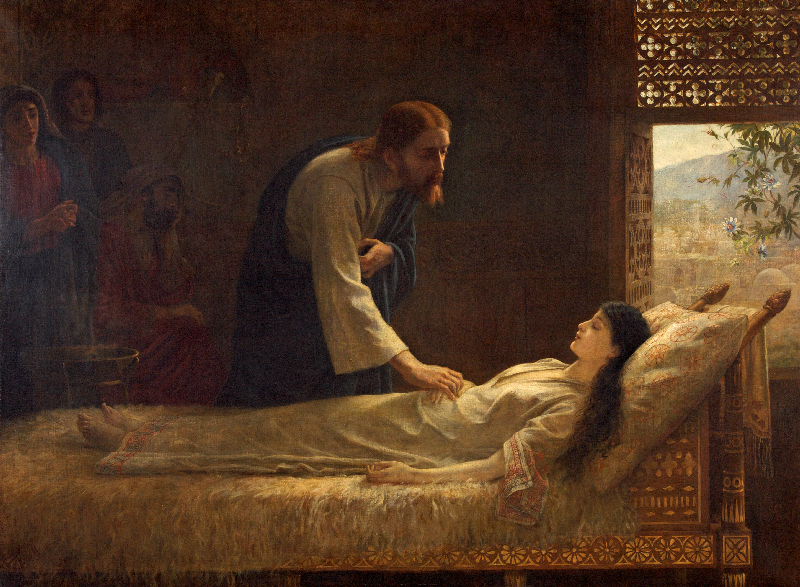
The Raising of Jairus' Daughter

Title: The Raising of Jairus' Daughter

Artist: Edwin Longsden Long

Medium: oil on canvas

Size: 163 x 183 cm

Date: 1889

Location: Victoria Art Gallery, Bath.


Mark 5:35-43: While Jesus was still speaking, some men came from the house of Jairus, the synagogue ruler. "Your daughter is dead," they said. "Why bother the teacher any more?" Ignoring what they said, Jesus told the synagogue ruler, "Don't be afraid; just believe." He did not let anyone follow him except Peter, James and John the brother of James. When they came to the home of the synagogue ruler, Jesus saw a commotion, with people crying and wailing loudly. He went in and said to them, "Why all this commotion and wailing? The child is not dead but asleep." But they laughed at him. After he put them all out, he took the child's father and mother and the disciples who were with him, and went in where the child was. He took her by the hand and said to her, "Talitha koum!" (which means, "Little girl, I say to you, get up!" ). Immediately the girl stood up and walked around (she was twelve years old). At this they were completely astonished. He gave strict orders not to let anyone know about this, and told them to give her something to eat.


The artist shows the most dramatic of moment of this passage, just before the girl comes back to life. Her parents and a disciple watch with anticipation as the miracle takes place. Jesus had sent the faithless outside, put them out, keeping only those who believed with him in the room. The window to the right of the picture, with a view of the city of Nazareth, is the primary source of light within the scene. But the reflection off the face of Jesus, most notably the illumination provided on his mouth and beard, make it seem as though the words ‘Talitha koum” are also a source of light.


Edwin Long (12 July 1829 – 15 May 1891) was an English genre, history, and portrait painter, born at Kelston, near Bath. After working locally as a portrait painter, he moved to London in the 1850s and became a very successful artist, painting Middle Eastern scenes populated with beautiful young women. Long was elected an associate of the Royal Academy in 1870 and an academician (RA) in 1881. Although he only painted a few Biblical pictures, religion was very important to Long. His parents had given him a religious upbringing; they were Congregationalist Dissenters and attended chapel regularly. Long never forgot his place of birth: in the 1880s he moved into an imposing house which he called Kelston.

Thursday, April 1, 2010

Mary Magdalene Announcing the Resurrection to the Apostles

Title: Mary Magdalene Announcing the Resurrection to the Apostles

Artist: Unknown

Medium: Illumination on parchment

Size: 18 x 14 cm

Date: c. 1123

Location: St. Albans Psalter, St Godehard's Church, Hildesheim.


Mark 16:10-11 She went and told those who had been with him and who were mourning and weeping. When they heard that Jesus was alive and that she had seen him, they did not believe it.


Yet again, the disciples are unable to grasp the magnitude of what has occurred. Despite Jesus having told them on a number of occasions that he would be raised from the dead (e.g. Mark 9:9-10), they refused to believe what Mary Magdalene had to report.


The St Albans Psalter, also known as the Albani Psalter or the Psalter of Christina of Markyate, is an English illuminated manuscript, one of several Psalters known to have been created at or for St Albans Abbey in the 12th century. It is widely considered to be one of the most important examples of English Romanesque book production. The almost unprecedented lavishness of decoration contains a number of iconographic innovations that would endure throughout the Middle Ages.


The main artist decorating the St Albans Psalter is called the ‘Alexis Master’ after a section of the work which contains the biography of a fifth-century Roman saint called Alexis. The Alexis Master is credited with introducing a new figurative and narrative style into English art in the 1120s. This new style was much indebted to eleventh-century German and early twelfth-century Italo-Byzantine style.

Monday, December 14, 2009

The Three Kings before Herod

Title: The Three Kings before Herod

Artist: Unknown

Medium: Watercolor on paper

Size: tbd

Date: c.1120 - 1145.

Location: From the St Albans Psalter, St Godehard Dombibliothek, Hildesheim.


Matthew 2:1-8 reiterates that Jesus was born in Bethlehem in Judea, and places the event during the reign of King Herod. About that time some wise men from eastern lands arrived in Jerusalem, asking, “Where is the newborn king of the Jews? We saw his star as it rose, and we have come to worship him.”


King Herod was deeply disturbed when he heard this, as was everyone in Jerusalem. He called a meeting of the leading priests and teachers of religious law and asked, “Where is the Messiah supposed to be born?”


“In Bethlehem in Judea,” they said, “for this is what the prophet wrote: ‘And you, O Bethlehem in the land of Judah, are not least among the ruling cities of Judah, for a ruler will come from you who will be the shepherd for my people Israel.’”


Then Herod called for a private meeting with the wise men, and he learned from them the time when the star first appeared. Then he told them, “Go to Bethlehem and search carefully for the child. And when you find him, come back and tell me so that I can go and worship him, too!”


This illustration depicts Herod seated in his distinct space, holding an open book which he discussed with the kings, while a sword bearer stands behind him. Herod consults the prophecy of Micah to locate Bethlehem as the birthplace of the Messiah. Facing him, and gesticulating in animated fashion, the three kings stand in order of seniority, led by the oldest with a white beard. The star shines beyond the margin.


The St Albans Psalter, also known as the Albani Psalter or the Psalter of Christina of Markyate, is an English illuminated manuscript, one of several Psalters known to have been created at or for St Albans Abbey in the 12th century. It is widely considered to be one of the most important examples of English Romanesque book production: it is of almost unprecedented lavishness of decoration and contains a number of iconographic innovations that would endure throughout the Middle Ages. Scholarly opinion differs on many of the details, but there is general agreement that the Psalter was created at St Albans Abbey during the abbacy of Geoffrey de Gorham or Gorron (1119-1146), and that it was probably owned by Christina of Markyate (born circa 1098, died perhaps between 1155 and 1166), anchoress and later prioress of Markyate.

Thursday, December 10, 2009

The Nativity

Title: The Nativity

Artist: Arthur Hughes

Medium: Oil and gold leaf on canvas

Size: 36 x 61 cm

Date: 1858

Location: Birmingham Museums and Art Gallery.


While in Bethlehem for the census, Luke 2:6-7 records that when the time came for the baby to be born, Mary gave birth to her firstborn, a son, and she wrapped him in swaddling clothes.


If ever there was an opportunity for God to enact his plan with a majestic flourish, it was at Jesus' birth. But God did not presume upon humanity when he stepped in to redeem it. There was no pretense in this arrival. Rather, God chose to identify in the humblest way with those made in his image.


Hughes painting of the nativity is unusual in its depiction of Mary as an adolescent; she is traditionally portrayed as a fully-grown woman. Here, Hughes shows her undertaking one of her first duties as a mother, wrapping her child in swaddling bands, an act which prefigures his entombment. The tenderness and care with which she carries out her task further reminds us of her youth and, that as a first time mother, she has much to learn in order to look after the infant Christ. Despite her bewildering predicament she is aided by two angels and watched by three others from above. Their presence highlights the fact that she is not alone and that both mother and baby will be watched over by God. A vivid palette of purple and pinks was used to paint the celestial figures. Their wings almost burst out of the picture frame creating a sense of dynamism within the composition, but also giving a sense of the cramped, intimate space in which the miracle of Christ's birth took place. Although Mary, as the central figure, dominates the painting Hughes draws are attention to the Christ child, the most important figure, by crowning him in a nimbus, a style of halo favored in Renaissance paintings.


Arthur Hughes (27 January 1832 – 22 December 1915), was an English painter and illustrator associated with the Pre-Raphaelite Brotherhood. Arthur Hughes met Dante Gabriel Rossetti (1828-1882) in 1850 and soon became the best of the younger Pre-Raphaelite followers. His work is noted for the magical glowing coloring and delicate draftsmanship. Hughes died in Kew Green, London, leaving about 700 known paintings and drawings, along with over 750 book illustrations.