Showing posts with label Crucifixion. Show all posts

Sunday, January 28, 2018

MEDITATIONS FOR MIDWINTER: PART 1


Title: Landscape with Snow and the Crucifixion
Artist: Karel van Mander, the Elder
Medium: Oil on panel
Size: 67 x 118 cm
Date: 1599
Location: Private Collection

Though this painting is based on a work by Lucas van Leyden dated 1517, Karel van Mander uses this inspiration to create what is likely the first painting of the Crucifixion depicted with snow. Van Mander was following a tradition started by fellow Dutch painter Pieter Bruegel the Elder, who, about thirty years prior, had done a series of biblical paintings set in the Dutch winter. Due to the virtual disappearance of religious painting from the Protestant society of the Netherlands, preference had shifted to non-religious themes such as still life and landscape painting, and Bruegel had started a vogue for Netherlandish winter paintings.

Dark skies and snowy hills dominate this landscape of Golgotha. Banners and cloaks billow in the winter wind while hungry dogs scavenge the bones of dead animals littered among barren trees. As the mortal life drains from Jesus, the earth itself waits, dormant and lifeless. Van Mander, with his use of stark contrast between sky and snow, was able to produce a stunning landscape depicting a Flemish winter, and still capture a scene charged with more emotional resonance than many of Bruegel’s preceding works.

Karel van Mander, the Elder (1548 - 1606) was a Dutch Mannerist painter, poet, and writer whose fame is principally based upon a biographical work on painters - Het Schilder-boeck (1604; "The Book of Painters"). Born of a noble family at Meulebeke in Flanders, van Mander studied under Lucas de Heere at Ghent, and under Pieter Vlerick at Courtrai and Tournai. After much wandering, in 1583 he settled at Haarlem, where he co-founded a successful academy of painting. Van Mander's paintings, which were mainly religious and allegorical, adopted the elongated forms of the Mannerist, but his later works showed a greater tendency towards naturalism.

Sunday, April 9, 2017

Luke for Lent - Part 6 of 7

Title: The Three Crosses
Artist: Peter Paul Rubens
Medium: Oil on panel
Size: 60.5 x 96 cm
Date: ca. 1620
Location: Museum Boijmans Van Beuningen, Rotterdam

Luke 23:39-43 One of the criminals who hung there hurled insults at him: “Aren’t you the Messiah? Save yourself and us!” But the other criminal rebuked him. “Don’t you fear God,” he said, “since you are under the same sentence? We are punished justly, for we are getting what our deeds deserve. But this man has done nothing wrong.” Then he said, “Jesus, remember me when you come into your kingdom.” Jesus answered him, “Truly I tell you, today you will be with me in paradise.”

The faith of the thief on the cross is often dismissed, for he has the equivalent of a deathbed conversion. But the testimony he gives in his last moments is a most eloquent evidence of faith. He addresses his colleague first, expresses the injustice of the entire crucifixion by exclaiming, "We are punished justly, for we are getting what our deeds deserve. But this man has done nothing wrong." Then, anticipating the restoration and resurrection, the thief turns to Jesus with words full of faith, and asks to be included. This man, despite a life full of sin, comes to Jesus, and seeks forgiveness in his last mortal moments. He confesses his guilt and casts himself on Jesus' mercy and saving power. Ironically, though dying amidst mocking, Jesus has saved while on the cross. The request of the taunts has been granted to one who learned to believe. Luke could not have painted a clearer portrait of God's grace…

Peter Paul Rubens (1577 – 1640) was a Flemish/Netherlandish draughtsman and painter, widely considered as the most notable artist of Flemish Baroque art school. A proponent of an extravagant Baroque style that emphasised movement, colour, and sensuality, Rubens is well known for his Counter-Reformation altarpieces, portraits, landscapes, and history paintings of mythological and allegorical subjects. Art experts have pointed out that Rubens did not intend the three towering crosses in this painting to have such a dramatic impact. It was only later that his original panel was mounted in a larger one. However, the work was reproduced in its present form during his lifetime, so the idea of portraying Christ’s death so bleakly is certainly authentic and came from Rubens’s circle.

Wednesday, December 25, 2013

The Twelve Days of Christmas - Day 1

Title: Crucifixion
Artist: Franz von Stuck
Medium: Tempera on canvas
Size: 190 x 165 cm
Date: tbd.
Location: Museum der Bildenden Künste, Leipzig.
 
A bit of modern folklore asserts that the lyrics of the Christmas carol “The Twelve days of Christmas” were written as a catechism song to help young Catholics learn their faith at a time when practising Catholicism was criminalized in England (1558 - 1829). As summarized by Wikipedia: “There is no primary evidence supporting this claim, and no evidence that the claim is historical, or anything but a fanciful modern day speculation.” Indeed, the theory seems of relatively recent origin, first suggested by Canadian English teacher and hymnologist Hugh D. McKellar in a short article published in 1979. Regardless, the idea that the lyrics of the carol can represent something more than “merely an irreligious travesty” gives the song a deeper, more resonant meaning. And with that in mind, “The Twelve Days of Christmas”:
 
On the first day of Christmas my true love gave to me, a Partridge in a Pear Tree.
 
The symbolism speaks clearly to the image of Jesus on the Cross. Jesus Christ, symbolized as a mother partridge that feigns injury to decoy predators from helpless nestlings. And the pear tree represented as cross.

Sunday, March 25, 2012

Fifth Sunday of Lent - Christ on the Cross

Title: Christ on the Cross
Artist: Eugène Delacroix
Medium: Oil on canvas
Size: 80 x 64.2 cm
Date: 1846
Location: The Walters Art Museum, Baltimore.

John 19:31-37 - Now it was the day of Preparation, and the next day was to be a special Sabbath. Because the Jewish leaders did not want the bodies left on the crosses during the Sabbath, they asked Pilate to have the legs broken and the bodies taken down. The soldiers therefore came and broke the legs of the first man who had been crucified with Jesus, and then those of the other. But when they came to Jesus and found that he was already dead, they did not break his legs. Instead, one of the soldiers pierced Jesus’ side with a spear, bringing a sudden flow of blood and water. The man who saw it has given testimony, and his testimony is true. He knows that he tells the truth, and he testifies so that you also may believe. These things happened so that the scripture would be fulfilled: “Not one of his bones will be broken,” and, as another scripture says, “They will look on the one they have pierced.

Sharply silhouetted against the darkened sky is the dying Christ. A couple of gesturing spectators appear at the left, and on the right are two mounted Roman soldiers with billowing banners. Other onlookers are visible in the mid-ground. Although not a practicing Christian, Delacroix painted a number of New Testament subjects. Evidently, he was attracted to the drama of Christ's Passion and was endeavoring to deal with issues of personal faith raised by Christ's human and divine nature. When this work was exhibited at the Paris Salon in 1847, the critics enthusiastically praised it, noting its affinities with Crucifixion scenes by the great Flemish master Peter Paul Rubens.

Ferdinand Victor Eugene Delacroix (April 1798 – August 1863) was a French Romantic artist regarded from the outset of his career as a leader of the French Romantic school. In 1815 he entered the studio of the neoclassical painter Pierre Narcisse Guérin, where he met Théodore Géricault, a romantic painter by whom he was much influenced. Delacroix took for his inspiration the art of Rubens and painters of the Venetian Renaissance, with an attendant emphasis on color and movement rather than clarity of outline and carefully modeled form. Delacroix's use of expressive brushstrokes and his study of the optical effects of color profoundly shaped the work of the Impressionists, while his passion for the exotic inspired the artists of the Symbolist movement.

Sunday, March 18, 2012

Fourth Sunday of Lent - Crucifixion


Title: Crucifixion
Artist: Jörg Breu the Elder
Medium: Oil on wood
Size: 87 x 63 cm
Date: 1524
Location: Szépmûvészeti Múzeum, Budapest.


Luke 23:32-43 - Two other men, both criminals, were also led out with him to be executed. When they came to the place called the Skull, they crucified him there, along with the criminals—one on his right, the other on his left. Jesus said, “Father, forgive them, for they do not know what they are doing.” And they divided up his clothes by casting lots. The people stood watching, and the rulers even sneered at him. They said, “He saved others; let him save himself if he is God’s Messiah, the Chosen One.” The soldiers also came up and mocked him. They offered him wine vinegar and said, “If you are the king of the Jews, save yourself.” There was a written notice above him, which read: THIS IS THE KING OF THE JEWS. One of the criminals who hung there hurled insults at him: “Aren’t you the Messiah? Save yourself and us!” But the other criminal rebuked him. “Don’t you fear God,” he said, “since you are under the same sentence? We are punished justly, for we are getting what our deeds deserve. But this man has done nothing wrong.” Then he said, “Jesus, remember me when you come into your kingdom.” Jesus answered him, “Truly I tell you, today you will be with me in paradise.”

Luke’s gospel describes how Jesus and two criminals head to their fate. The Greek term describing the other offenders, kakourgos, is a generic one for "lawbreaker" (Prov 21:15). Mark 15:27 and Matthew 27:38 describe the men with the term lestes, which can mean "bandit" or "revolutionary." This is the word Jesus used to question his arrest in Luke 22:52. The other Synoptics mention these thieves, but they only note that they reviled Jesus. Apparently one of them has a change of heart, however, as he hears Jesus intercede for others and watches him tolerate the taunts. This criminal anticipates the restoration and resurrection, and asks to be included. His depth of perception stands in contrast to the blindness of those who taunt. This thief, despite a life full of sin, comes to Jesus and seeks forgiveness in his last mortal moments. He confesses his guilt and casts himself on Jesus' mercy and saving power. Luke could not have painted a clearer portrait of God's grace.

Jörg Breu the Elder was a German painter and designer of woodcuts whose subjects included portraits, altarpieces and battle scenes. He was one of the leading painters of his time in Augsburg, and was patronized by both the emperor Maximilian and by Duke William IV of Bavaria. His style was complex and detailed, sharing something of Altdorfer's passion and love of landscape, and showing strong influence from Dürer and a journey he made to Italy in about 1514.

Friday, August 5, 2011

19 IMAGES FROM THE 19th CENTURY: PART 18 -The Calvary

Title: The Calvary
Artist: Odilon Redon
Medium: Pastel on cardboard
Size: 69 x 53 cm
Date: c. 1895
Location: Foundation E. G. Bührle Collection, Zurich.

19 IMAGES FROM THE 19th CENTURY: PART 18

Mark 15:25 And it was the third hour, and they crucified him.

Around the middle of the 1890s a religious mysticism takes the place of the dark visions of Redon’s work. Charcoal gives way to the bright pastel, and Christ figures prominently in his work. In "The Calvary" this new Redon, tense with religious hopes, tense also in the sense that he is subject to restrictive compulsions: the overemphasized "sacral" central axis of the Cross with the small crucified figure on the upper margin of the picture and the rigid, lamenting Mary in her red robe. It is to she whom the viewers eye is drawn, and we are forced to contemplate her plight, under Redon’s shimmering sky.

Bertrand-Jean Redon, better known as Odilon Redon (April 1840 – July 1916) was a French symbolist painter, printmaker, draughtsman and pastellist. The young Bertrand-Jean Redon acquired the nickname "Odilon" from his mother, Odile. Redon started drawing as a child, and at the age of ten he was awarded a drawing prize at school. Aged fifteen, he began the formal study of drawing, but on the insistence of his father he changed to architecture. His failure to pass the entrance exams at Paris’ École des Beaux-Arts ended any plans for a career as an architect. In the 1890s, pastel and oils became his favored media, and he produced no more noirs after 1900.

Sunday, July 31, 2011

19 IMAGES FROM THE 19th CENTURY: PART 13 - The Deposition

Title: The Deposition
Artist: Arnold Böcklin
Medium: Tempera and colored varnish on panel
Size: 160 x 250 cm
Date: c. 1874
Location: Nationalgalerie, Berlin.

19 IMAGES FROM THE 19th CENTURY: PART 13

John 19:38-40 And after these things Joseph of Arimathaea, who was a disciple of Jesus, but secretly through fear of the Jews, demanded of Pilate that he might take the body of Jesus: and Pilate allowed it. He came therefore and took away the body of Jesus. And Nicodemus also, who at first came to Jesus by night, came, bringing a mixture of myrrh and aloes, about a hundred pounds. They took therefore the body of Jesus and bound it up in linen with the spices, as it is the custom with the Jews to prepare for burial.

This painting demonstrates Böcklin's flair for archaization, one already employed by the Nazarenes, is seen in the Quattrocento coloring of this Deposition. A color palate consisting primarily of musty blues and greens, a deathly pallor covers the whole scene, as though the shade of Christ’s body is emanating and tinting the whole of the world. Part camp theatricality, part convinced and convincing Christianity, part prophecy, this canvas proved to be an Avant-Garde and unpopular work when first exhibited at the Vienna Exposition.

Arnold Böcklin (October 1827 –January 1901) was a Swiss symbolist painter. He was on of the major Swiss painter of the 19th century, and he exerted a great influence on the German-speaking countries through the expression of a heightened Romanticism and poeticism. He was trained in Germany, Flanders, and Paris, and spent seven years in Rome (1850-57), where he transformed his early naturalistic landscapes, more or less in the manner of Corot, into symbolic subjects with figures epitomizing the mood of the landscape. He was in Munich in 1871-74, in 1885 in Hottingen (Switzerland). However, like other German artists of the period, he spent much of rest of his life in Italy, where he died in Fiesole near Florence.

Thursday, March 31, 2011

Christ on the Cross

Title: Christ on the Cross
Artist: Eugène Delacroix
Medium: Oil on Canvas
Size: 73.5 x 59.7 cm
Date: 1853
Location: The National Gallery, London.

John 19:31-37 Now it was the day of Preparation, and the next day was to be a special Sabbath. Because the Jewish leaders did not want the bodies left on the crosses during the Sabbath, they asked Pilate to have the legs broken and the bodies taken down. The soldiers therefore came and broke the legs of the first man who had been crucified with Jesus, and then those of the other. But when they came to Jesus and found that he was already dead, they did not break his legs. Instead, one of the soldiers pierced Jesus’ side with a spear, bringing a sudden flow of blood and water. The man who saw it has given testimony, and his testimony is true. He knows that he tells the truth, and he testifies so that you also may believe. These things happened so that the scripture would be fulfilled: “Not one of his bones will be broken,” and, as another scripture says, “They will look on the one they have pierced.”

Although not a practicing Christian, Delacroix painted a number of New Testament subjects. Evidently, he was attracted to the drama of Christ's Passion and was endeavoring to deal with issues of personal faith raised by Christ's human and divine nature. Delacroix painted this subject several times throughout his career. One version showing Christ between the two thieves was exhibited at the Salon of 1835 (Musée Municipal des Beaux-Arts, Vanne). Another version of 1846, closely related to this painting, was shown at the Salon of 1847 and is now in the Walters Art Gallery, Baltimore.

Eugène Delacroix (April 1798 – August 1863) was a French Romantic artist regarded from the outset of his career as the leader of the French Romantic school. Delacroix's use of expressive brushstrokes and his study of the optical effects of color profoundly shaped the work of the Impressionists, while his passion for the exotic inspired the artists of the Symbolist movement. Renoir and Manet made copies of his paintings, and Degas purchased the portrait of Baron Schwiter for his private collection. Delacroix was trained by the Neo-classical painter Pierre Guérin, from 1816 to about 1823. In style his work shows the influence of painters he had studied, notably Rubens. He was an admirer of English painting, and visited England in 1825. In 1832 he travelled to Spain, Morocco and Algiers. After the Revolution of 1830 he was favored by Louis-Philippe, and later by Napoleon III, with a long series of official commissions, beginning in 1833 with a series of decorations in the Palais Bourbon.

Wednesday, March 30, 2011

Christ on the Cross

Title: Christ on the Cross
Artist: Francisco de Zurbarán
Medium: Oil on Canvas
Size: 106 x 110.2 cm
Date: 1627
Location: Art Institute, Chicago.

John 19:28-30 Later, knowing that everything had now been finished, and so that Scripture would be fulfilled, Jesus said, “I am thirsty.” A jar of wine vinegar was there, so they soaked a sponge in it, put the sponge on a stalk of the hyssop plant, and lifted it to Jesus’ lips. When he had received the drink, Jesus said, “It is finished.” With that, he bowed his head and gave up his spirit.

On one level the idea of thirst also has spiritual significance. Earlier Jesus had said, "My food . . . is to do the will of him who sent me and to finish his work" (4:34). And when he was arrested he told Peter to put his sword away, saying, "Shall I not drink the cup the Father has given me?" (18:11). Hunger and thirst become images for Jesus' desire to fulfill the Father's will to the end. Since the cup represents wrath and suffering, Jesus' taking of this drink may suggest the completion of that experience, as the Lamb of God now takes away the sin of the world. The work he has come to do is now complete. The great significance John attaches to the saying would symbolize both Jesus' commitment to obey God's will and the fulfillment of the suffering of the one who is the righteous sufferer.

Francisco de Zurbarán (November 1598 – August 1664) was a Spanish painter known primarily for his religious paintings depicting monks, nuns, and martyrs. Zurbarán gained the nickname Spanish Caravaggio, owing to the forceful, realistic use of chiaroscuro in which he excelled. His subjects were mostly severe and ascetic religious vigils, the spirit chastising the flesh into subjection, the compositions often reduced to a single figure. In 1627, while still resident in Llerena, Zurbarán painted this spectacular picture, that made him famous, for the Dominicans. It was placed in a small oratory chapel and made a strong impression. The represented drama in the composition is increased by the overpowering light, which heightens then transforms the real into superreal, thus expressing the dual nature of Christ.

Tuesday, March 29, 2011

Golgotha

Title: Golgotha
Artist: Franz von Stuck
Medium: Oil on Canvas
Size: 106 x 110.2 cm
Date: 1917
Location: Brooklyn Museum, Brooklyn.

John 19:25-27 Near the cross of Jesus stood his mother, his mother’s sister, Mary the wife of Clopas, and Mary Magdalene. When Jesus saw his mother there, and the disciple whom he loved standing nearby, he said to her, “Woman, here is your son,” and to the disciple, “Here is your mother.” From that time on, this disciple took her into his home.

One of Germany’s leading Symbolists, Stuck frequently painted biblical or mythological subjects that addressed dark themes such as sin and death. Particularly interested in the narrative and details of the Crucifixion, Stuck devoted several canvases to this subject late in his career, during the difficult years of World War I. Calling on new scholarly theories regarding the Gospel accounts, Stuck departs from tradition and places Christ at eye level with the witnesses to his sufferings. The artist cleverly structures his composition, placing the viewer immediately to the left of the crucified thief in the foreground and to the right of the haloed Virgin Mary, thereby closing a solemn yet intimate circle. Stuck also chooses to show Christ with his feet side by side rather than overlapping—again, referencing nineteenth-century debates about the historical details of this method of execution.

Franz Von Stuck (February, 1863 - August 30, 1928) was a German painter, sculptor, engraver and architect. He at first earned his living by illustrating various magazines, and in 1892 was one of the founders of the Munich Sezession. In 1895 he began teaching at the Munich Academy, where his pupils included Kandinsky, Klee and Albers, whose subsequent careers enhanced von Stuck's fame. His many nudes, with their torrid sensuality and a linear style combining decorative and erotic elements, are direct precursors of Jugendstil, the German Art Nouveau movement.

Monday, March 28, 2011

The Crucifixion

Title: The Crucifixion
Artist: Frank Mason
Medium: Oil on panel
Size: 86.36 x 60.96 cm
Date: 1998
Location: Private collection.

John 19:23-24 When the soldiers crucified Jesus, they took his clothes, dividing them into four shares, one for each of them, with the undergarment remaining. This garment was seamless, woven in one piece from top to bottom. “Let’s not tear it,” they said to one another. “Let’s decide by lot who will get it.” This happened that the scripture might be fulfilled that said, “They divided my clothes among them and cast lots for my garment.” So this is what the soldiers did.

The significance of the garment's being seamless is that the soldiers are led to draw of lots for it, which in turn echoes Psalm 22:18 – “They divide my clothes among them and cast lots for my garment”. This is the first of four Old Testament passages cited as being fulfilled in Jesus' Passion, all of which refer to particular details of what takes place. John marshals these texts around this most central, and most scandalous, event in order to show that the death of God's Son was in fact the will of God the Father. Behind the idea of fulfillment is the notion of God's sovereign control, which weaves repeating patterns: Scripture expresses God's will, and Jesus is submissive to God's will, so his activity fulfills the Scripture because it flows from the same source and is controlled by the same Father.

Frank Herbert Mason (February 1921- June 2009) was an American painter and teacher born in Cleveland, Ohio. He attended the Music and Arts High School in New York until he was awarded a scholarship to study at the Art Students League of New York with Frank DuMond. Mason studied with Dumond until DuMond's death in 1951, when he himself began teaching at the Art Students League. Mason takes his place in a long line of Old Masters who have interpreted the New Testament, and, like them, he has succeeded in infusing the dignity of his craft and the expression of faith.

Sunday, March 27, 2011

The Crucifixion of Christ

Title: The Crucifixion of Christ
Artist: Tintoretto (Jacopo Robusti)
Medium: Oil on canvas
Size: 341 x 371 cm
Date: 1568
Location: San Cassiano, Venice.

John 19:19-22 Pilate had a notice prepared and fastened to the cross. It read: JESUS OF NAZARETH, THE KING OF THE JEWS. Many of the Jews read this sign, for the place where Jesus was crucified was near the city, and the sign was written in Aramaic, Latin and Greek. The chief priests of the Jews protested to Pilate, “Do not write ‘The King of the Jews,’ but that this man claimed to be king of the Jews.” Pilate answered, “What I have written, I have written.”

Common practice was to have those sentenced to crucifixion carry signs indicating the cause of their punishment, or to have others carry the signs for the accused. The title Pilate has written continues to goad the Jewish leaders, and they insist that he change it. But for the first time he stands firm against them, and John seems to suggest this title over the cross was itself a form of witness to Israel and the world. Pilate unwittingly made such a proclamation, of course, as was the case with his having chosen the title itself. Such features fit with John's theme that all is working out according to God's will. So here we have another irony: the man who does not have a clue about the truth proclaims, unwittingly, the truth about Jesus. And we have the tragedy of the representatives of the one true God, who should have recognized the truth, continuing to reject it.

Tintoretto (September, 1518 – May, 1594) also known as Jacopo Robusti or Jacopo Comin, was an Italian painter and a notable exponent of the Venetian Renaissance school. His father, Giovanni, was a dyer, or tintore; hence the son got the nickname of Tintoretto, little dyer, or dyer's boy. For his phenomenal energy in painting he was termed Il Furioso. Indeed, fellow Venetian master Sebastiano del Piombo remarked that Tintoretto could paint in two days as much as himself in two years. Like Titian, Tintoretto kept a huge workshop, his chief assistants being his sons Domenico and Marco, and his daughter Marietta. Domenico became his foreman and is said to have painted many portraits, although none can be attributed to him with certainty.

Saturday, March 26, 2011

Calvary

Title: Calvary
Artist: Nikolai Ge
Medium: Oil on canvas
Size: 278 x 223 cm
Date: 1892
Location: Musée d'Orsay, Paris.

John 19:18 There they crucified him, and with him two others—one on each side and Jesus in the middle.

Ge reworked this canvas several times, as evidenced by the figure of the Roman centurion looming up unfinished, or partly repainted, in the background. He tried by formal means to translate the moral torment and suffering by accentuating the expressiveness of the faces, and refusing the academic vision of an ideal, inhuman body, unaltered by the Passion. The dramatic lighting intensifies the violent emotion that he wanted to trigger in the spectator. The work was considered shocking and near-blasphemous, and Tsar Alexander ordered it to be withdrawn from the 22nd exhibition of the Itinerants where it was shown for the first time.

Nikolai Nikolayevich Ge (February 1831 –June 1894), a Russian artist, was born into a noble family of French origin. His parents died when he was young and he was raised by his serf nurse, who taught him compassion for the humiliated and a keen sense of other people’s sorrows. Ge entered the St. Petersburg Academy of Arts in 1850, graduating in 1857 with a Major Gold Medal for his picture The Witch of Endor Calling up the Spirit of the Prophet Samuel. He traveled extensively over the next dozen years, finally settling in St. Petersburg in 1870 where he became one of the founders of the Peredvizhniki, the Society of Traveling Art Exhibitions. He was not a practicing Orthodox, but was deeply influenced by morality and Christian spirituality. He spent the last years of his life working on a cycle of paintings of the Passion of Christ, under the influence of the progressive writer Leo Tolstoy.

Thursday, February 17, 2011

Christ With Shopping Bags

Title: Christ With Shopping Bags
Artist: Banksy
Medium: Screenprint on wove paper
Size: 50 x 70 cm
Date: 2004
Location: Various; published by Pictures On Walls, London, edition of 82.

With this print Banksy makes us think about what art is, the nature of symbols, and how it connects with the reality of our lives. With stark juxtaposition the artist challenges values and popular culture. Jesus does much the same thing in relation to God; he seemed to be out of place in the synagogue and temple, always making shock waves and causing controversy. He also connected through humor, irony, vivid imagery. Originally released in 2004, and ranks as one of the lowest edition Banksy prints. Just 82 prints of this edition exist, all of which were signed.

Apparently born in Bristol in 1975, Banksy's location as well as real name is not publicly known. Graffiti artist, political activist, painter and decorator - the work of Banksy is unmistakable. His satirical street art and subversive epigrams combine irreverent dark humor with graffiti done in a distinctive stenciling technique, and have been featured on streets, walls, and bridges of cities throughout the world. Though his identity remains unknown, his work is prolific, and his art is included in some of the most important private collections in the World. On June 13, 2009, the Banksy UK Summer show, titled 'Banksy versus Bristol Museum’ opened at Bristol City Museum and Art Gallery, featuring more than 100 works of art, including ‘Christ With Shopping Bags’.

Thursday, August 19, 2010

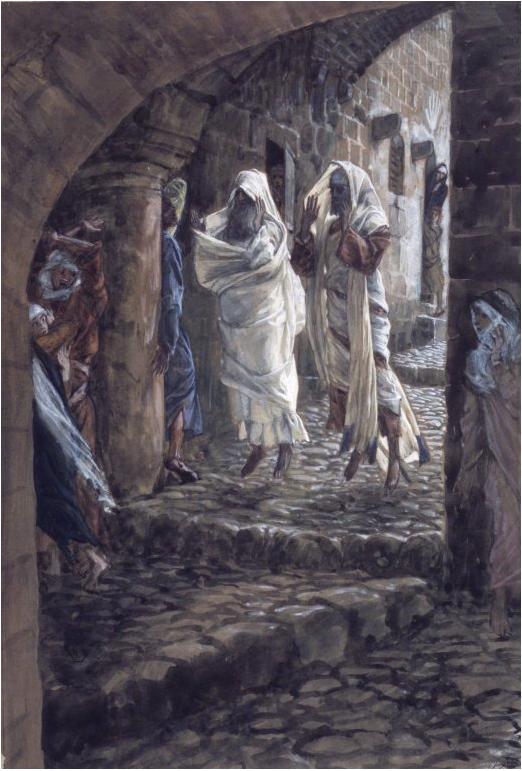
The Dead Appear in Jerusalem

Title: The Dead Appear in Jerusalem

Artist: James Tissot

Medium: Opaque watercolor over graphite on gray wove paper

Size: 27.6 x 19 cm

Date: c. 1890

Location: Brooklyn Museum, Brooklyn, New York.


Matthew 27:50-54: And when Jesus had cried out again in a loud voice, he gave up his spirit. At that moment the curtain of the temple was torn in two from top to bottom. The earth shook and the rocks split. The tombs broke open and the bodies of many holy people who had died were raised to life. They came out of the tombs, and after Jesus' resurrection they went into the holy city and appeared to many people. When the centurion and those with him who were guarding Jesus saw the earthquake and all that had happened, they were terrified, and exclaimed, "Surely he was the Son of God!"


To both pagan and Jewish audiences these signs would indicate divine approval of Jesus and disapproval of his executioners. The raising of dead persons at Jesus' death reminds us that by refusing to save himself, Jesus did save others. Yet by mentioning only “many” of the saints, Matthew clearly intends this sign merely to prefigure the final resurrection, proleptically signified in Jesus' death and resurrection


James Jacques Joseph Tissot (October 15, 1836 – August 8, 1902) was a French painter. To the surprise of all his friends, he suddenly found religion in his late 40s and decided to tell the story of Christ's passion in 350 illustrations. He conceived them not only in the realist style, but in the Orientalist idiom of Gérôme and Fromentin. The guiding intellectual force behind the images was Ernest Renan, whose "Vie de Jésus" (1863), one of the most influential books of the 19th century, who undertook to track down "the historical Jesus." The point of Tissot's watercolors was not to diminish Christ, as critics alleged, but rather to make him acceptable to that part of contemporary culture that could no longer accept Christ through the gauze of scriptural authority, that had to see him face to face.

Tuesday, August 10, 2010

The Savior

Title: The Savior

Artist: Henry Ossawa Tanner

Medium: oil on canvas mounted on plywood

Size: 74 x 55 cm

Date: c 1900-05

Location: Smithsonian American Art Museum.


Luke 23:8-12: When Herod saw Jesus, he was greatly pleased, because for a long time he had been wanting to see him. From what he had heard about him, he hoped to see him perform some miracle. He plied him with many questions, but Jesus gave him no answer. The chief priests and the teachers of the law were standing there, vehemently accusing him. Then Herod and his soldiers ridiculed and mocked him. Dressing him in an elegant robe, they sent him back to Pilate. That day Herod and Pilate became friends—before this they had been enemies.


Like a terminally ill patient, Jesus knows that death is around the corner. Our mortality is a frightening thing. Jesus faces it by doing what he always did: he took his concerns to God in prayer. Jesus walks into his valley of the shadow of death through the heavenly courts of God's presence.


The story of Christ’s crucifixion occupied Henry Ossawa Tanner’s mind throughout his career. The Savior shows Jesus meditating as he waits for his crown of thorns and purple robe, in which he would be mocked as the “King of the Jews.” Tanner portrayed him as a real person in contemplation and prayer rather than as an idealized figure. But the yellow color in his face and outlining his profile is like a glowing light that suggests Christ’s uniqueness as a spiritual being, able to transcend flesh and blood.


Henry Ossawa Tanner (Pittsburgh, PA 1859 - Paris, France 1937) was an African American artist who earned international acclaim for his religious paintings. His father was a prominent minister and his mother a former slave who escaped the South through the Underground Railroad. At age eleven, Tanner decided to become an artist, and nine years later the Pennsylvania Academy of the Fine Arts accepted him, the only African American out of two hundred students. Throughout his life Tanner kept close ties with his native country and was proud of his contributions as a black American, but chose to live in France, where he felt that his race mattered less to other artists and critics.

Thursday, March 25, 2010

The Sorrows of the Mother of God

Title: The Sorrows of the Mother of God

Artist: Mikhail Petrovich Botkin

Medium: Oil on Canvas

Size: tbd.

Date: c. 1870

Location: tbd.


Mary, mother of Jesus, is depicted as forlorn. The three crosses used in the crucifixion are outlined against the setting sun, a reminder against the orange glow on the horizon. Mary, too, holds reminders of the trauma: left over linen and the crown of thorns are draped in her arms. She is a portrait of disbelieving grief.


Mikhail Petrovich Botkin (1839-1914) was an academically trained history painter, know for his Christian paintings and genre compositions. He came from a famous family in Russia. One of his brothers was a famous author, and another a brilliant. Botkin entered the Academy of Fine Arts in St Petersburg in 1856, but he left without finishing his studies there, and instead went to Italy using his own means. From there he also visited Germany, France, and Spain, studying the techniques of the artists in these countries. Botkin also worked in business, and was a director of several firms, including the Russian Steam Navigation and Trade Society, the first Russian insurance society, and a St Petersburg commercial bank. The means earned from such activity allowed him to support public initiatives developing young artists. Botkin was an avid art collector and connoisseur, and paintings from his collection were carried to many exhibitions in Russia and all over Europe.

Friday, March 19, 2010

The Crucifixion of Christ

Title: The Crucifixion of Christ

Artist: Carl Bloch

Medium: Etching

Size: 25 x 33 cm

Date: 1881

Location: Hope Gallery, Park City, UT


Just as he suffered alone, Christ is solitarily placed against the ominous sky looming above him. Being the focal point of the piece, his lifeless body brings the eye down to the mournful scene below him with Mary Magdalene, the Virgin Mother, and John the Beloved, all grieving in disbelief. John’s gaze carries the viewer to the three figures on the right approaching with a ladder and linens for Christ’s descension. Having been granted permission to remove Jesus’ body from the cross, this engraving depicts Joseph of Arimathea approaching triumphantly with the help needed to remove the Lord’s body.


Carl Heinrich Bloch (May 23, 1834 – February 22, 1890) was a Danish painter. He was born in Copenhagen and studied with Wilhelm Marstrand at the Royal Danish Academy of Art (Det Kongelige Danske Kunstakademi). His early work featured rural scenes from everyday life. From 1859 to 1866, Bloch lived in Italy. After many of Bloch’s paintings that were coming out of Italy were seen by influential patrons back home, he was commissioned to paint 23 new paintings for the King's Praying Chamber in the newly restored Frederiksborg Castle Chapel, in Hillerød, Denmark. Those paintings have become very popular illustrations, so much so that for over 40 years the Church of Jesus Christ of Latter-day Saints has made heavy use of the imagery in Bloch's paintings in its church buildings and printed media. Carl Bloch also excelled through his etchings. Sigurd Mueller, a leading Danish art critic, stated "No other Danish artist has given us so many great etchings as Carl Bloch".

Thursday, March 18, 2010

The Crucifixion with the Converted Centurion

Title: The Crucifixion with the Converted Centurion

Artist: Lucas Cranach the Elder

Medium: Oil on panel

Size: 51 x 35 cm

Date: 1536

Location: National Gallery of Art, Washington, DC.


Mark 15: 39-41 And when the centurion, who stood there in front of Jesus, heard his cry and saw how he died, he said, "Truly this man was the Son of God!"


Some women were watching from a distance. Among them were Mary Magdalene, Mary the mother of James the younger and of Joses, and Salome. In Galilee these women had followed him and cared for his needs. Many other women who had come up with him to Jerusalem were also there.


In this painting, Lucas Cranach the Elder chose to portray a scene of religious redemption. The crucified Christ, silhouetted against a darkened and troubled sky, is at the point of death; his last words from the cross are inscribed above him in German. At that moment, a Roman centurion, astride a white charger, recognizes Christ's divinity and pronounces: WARLICH DISER MENSCH IST GOTES SVN GEWEST (Truly, this man was the Son of God [Mark 15:39]). The theme of The Crucifixion with the Converted Centurion especially appealed to Protestants because it clearly illustrated the doctrine of salvation by faith alone, the central precept of their creed. The centurion, clothed in contemporary armor, symbolized the "Knight of Christ" who steadfastly defends his new-won belief despite all adversity.


Lucas Cranach the Elder (October 4, 1472 – October 16, 1553) was a German Renaissance painter and printmaker in woodcut and engraving. The largest proportion of Cranach's output is of portraits, and it is chiefly thanks to him that we know what the German Reformers and their princely adherents looked like. From 1505 until his death, Cranach was the court painter to three successive electors of Saxony. He became close friends with Luther - who lived in the Saxon town of Wittenberg - and is considered one of the foremost artists of the Reformation.

Wednesday, March 17, 2010

Crucifixion

Title: Crucifixion

Artist: Giotto di Bondone

Medium: Fresco

Size: 180 x 210 cm

Date: 1310s

Location: North transept, Lower Church, San Francesco, Assisi.


Mark 15:37-38 With a loud cry, Jesus breathed his last.


The curtain of the temple was torn in two from top to bottom.


The curtain of the temple separated the holiest part of the temple sanctuary from the rest of the sanctuary. This Holiest of Holies was understood to be the particular place of God’s presence. To say the curtain had been torn was to affirm that the execution of Jesus means that access to the presence of God is now open.


Giotto di Bondone (c. 1267 – January 8, 1337), better known simply as Giotto, was an Italian painter and architect from Florence in the late Middle Ages. He is generally considered the first in a line of great artists who contributed to the Italian Renaissance. In 1287, at the age of about 20, Giotto married Ricevuta di Lapo del Pela, known as "Ciuta". The couple had numerous children, (perhaps as many as eight) one of whom, Francesco, became a painter. From 1306 to 1311 Giotto was in Assisi, where he painted frescoes in the north transept area of the Lower Church, including The Life of Christ and various miracles by St Francis. The direct authorship of Giotto is debated, and many of these scenes were probably executed by Giotto's workshop under the direction of the master.