Showing posts with label Mark. Show all posts

Saturday, December 28, 2013

The Twelve Days of Christmas - Day 4

Title: Christ in Glory
Artist: Unknown
Medium: Tempera on parchment  
Size: tbd.
Date: 17th-century
Location: British Library, London.


On the fourth day of Christmas, my true love gave to me four calling birds...


Four Calling birds represent the Four Gospels of Mark, Matthew, Luke & John. This image, from an illuminated manuscript held at the British Library, London, is of the Christ in Glory, surrounded by traditional images depicting the Four Evangelists. Matthew, the author of the first gospel account is symbolized by a winged man, or angel. Mark, author of the second gospel account is symbolized by a winged lion – a figure of courage and monarchy. Luke, author of the third gospel account (and the Acts of the Apostles) is symbolized by a winged ox or bull – a figure of sacrifice, service and strength. John the Evangelist, author of the fourth gospel is symbolized by an eagle – a figure of the sky, and believed to be able to look straight into the sun.

Sunday, March 4, 2012

Second Sunday of Lent - Christ Taken Prisoner

Title: Christ Taken Prisoner
Artist: Giuseppe Cesari
Medium: Oil on walnut panel
Size: 89 x 62 cm
Date: c. 1597
Location: Staatliche Museen, Kassel.


Mark 14:43-52 - Just as he was speaking, Judas, one of the Twelve, appeared. With him was a crowd armed with swords and clubs, sent from the chief priests, the teachers of the law, and the elders. Now the betrayer had arranged a signal with them: “The one I kiss is the man; arrest him and lead him away under guard.” Going at once to Jesus, Judas said, “Rabbi!” and kissed him. The men seized Jesus and arrested him. Then one of those standing near drew his sword and struck the servant of the high priest, cutting off his ear. “Am I leading a rebellion,” said Jesus, “that you have come out with swords and clubs to capture me? Every day I was with you, teaching in the temple courts, and you did not arrest me. But the Scriptures must be fulfilled.” Then everyone deserted him and fled. A young man, wearing nothing but a linen garment, was following Jesus. When they seized him, he fled naked, leaving his garment behind.

As the armed mob takes Jesus captive, in a futile gesture, one of the disciples draws a sword and severs the ear of the high priest's servant. In Matthew's account this becomes an opportunity for Jesus to teach. He warns the disciple not to return violence for violence, for those who live by the sword die by the sword. In the Sermon on the Mount, Jesus had urged his disciples not to turn to violence; a child of God must love even the enemy. If it were a simple matter of displays of power, God could overwhelm Jesus' attackers with legions of angels. But God's reign revealed in the scriptures would not be imposed by violence. Jesus' fidelity would take him into the valley of death but, ultimately, the scriptures would be fulfilled and love would defeat violence and death.

Giuseppe Cesari (1568 – July 1640) was an Italian Mannerist painter, also named Il Giuseppino. Christ Taken Prisoner is one of Cesari's most important works, its popularity attested by the existence of a somewhat smaller version in the Galleria Borghese and of numerous copies. Cesari bathes the scene in a pale moonlight that gives the colors an almost metallic coolness. His rendering of the form of the moon, and of the stars shining with varying degrees of brightness, testifies to a growing interest in the realistic representation of the night sky. The picture must have been painted in Rome in 1596/97, when Cesari was working on one of his most important commissions, the fresco cycle for the Palazzo dei Conservatori.

Friday, August 5, 2011

19 IMAGES FROM THE 19th CENTURY: PART 18 -The Calvary

Title: The Calvary
Artist: Odilon Redon
Medium: Pastel on cardboard
Size: 69 x 53 cm
Date: c. 1895
Location: Foundation E. G. Bührle Collection, Zurich.

19 IMAGES FROM THE 19th CENTURY: PART 18

Mark 15:25 And it was the third hour, and they crucified him.

Around the middle of the 1890s a religious mysticism takes the place of the dark visions of Redon’s work. Charcoal gives way to the bright pastel, and Christ figures prominently in his work. In "The Calvary" this new Redon, tense with religious hopes, tense also in the sense that he is subject to restrictive compulsions: the overemphasized "sacral" central axis of the Cross with the small crucified figure on the upper margin of the picture and the rigid, lamenting Mary in her red robe. It is to she whom the viewers eye is drawn, and we are forced to contemplate her plight, under Redon’s shimmering sky.

Bertrand-Jean Redon, better known as Odilon Redon (April 1840 – July 1916) was a French symbolist painter, printmaker, draughtsman and pastellist. The young Bertrand-Jean Redon acquired the nickname "Odilon" from his mother, Odile. Redon started drawing as a child, and at the age of ten he was awarded a drawing prize at school. Aged fifteen, he began the formal study of drawing, but on the insistence of his father he changed to architecture. His failure to pass the entrance exams at Paris’ École des Beaux-Arts ended any plans for a career as an architect. In the 1890s, pastel and oils became his favored media, and he produced no more noirs after 1900.

Wednesday, August 3, 2011

19 IMAGES FROM THE 19th CENTURY: PART 16 - The Miracle of the Gaderene Swine

Title: The Miracle of the Gaderene Swine
Artist: Briton Riviere
Medium: Oil on Canvas
Size: 107.9 x 160.7 cm
Date: 1883
Location: Tate Gallery, London.

19 IMAGES FROM THE 19th CENTURY: PART 16

Mark 5:1-20 They went across the lake to the region of the Gaderene. When Jesus got out of the boat, a man with an impure spirit came from the tombs to meet him. This man lived in the tombs, and no one could bind him anymore, not even with a chain. For he had often been chained hand and foot, but he tore the chains apart and broke the irons on his feet. No one was strong enough to subdue him. Night and day among the tombs and in the hills he would cry out and cut himself with stones. When he saw Jesus from a distance, he ran and fell on his knees in front of him. He shouted at the top of his voice, “What do you want with me, Jesus, Son of the Most High God? In God’s name don’t torture me!” For Jesus had said to him, “Come out of this man, you impure spirit!” Then Jesus asked him, “What is your name?” He replied, “My name is Legion, for we are many.” And he begged Jesus again and again not to send them out of the area. A large herd of pigs was feeding on the nearby hillside. The demons begged Jesus, “Send us among the pigs; allow us to go into them.” He gave them permission, and the impure spirits came out and went into the pigs. The herd, about two thousand in number, rushed down the steep bank into the lake and were drowned. Those tending the pigs ran off and reported this in the town and countryside, and the people went out to see what had happened. When they came to Jesus, they saw the man who had been possessed by the legion of demons, sitting there, dressed and in his right mind; and they were afraid. Those who had seen it told the people what had happened to the demon-possessed man—and told about the pigs as well. Then the people began to plead with Jesus to leave their region. As Jesus was getting into the boat, the man who had been demon-possessed begged to go with him. Jesus did not let him, but said, “Go home to your own people and tell them how much the Lord has done for you, and how he has had mercy on you.” So the man went away and began to tell in the Decapolis how much Jesus had done for him. And all the people were amazed.

Jesus' request for the name of the demon brings the response Legion, a reference to a unit made up of thousands of soldiers. No doubt the name indicates the extent of the possession and the difficulty of Jesus' task in dealing with it. But the demons feared Jesus, feared being sent away, so they asked to be allowed to inhabit the swine on a nearby hill. The choice of pigs is interesting, given their association with uncleanliness in the Old Testament (Lev 11:7). It is not clear why the demons made such a request, other than to escape judgment. The demons' request is granted, but their relief is short-lived. The pigs apparently are startled and rush headlong over a cliff and into the sea. In Judaism the sea was a symbol of potential evil, so this becomes an illustration of evil's destructiveness. When the people travel out to the scene of the miracle, they see a transformed man sitting at Jesus' feet dressed and in his right mind. The people's reaction is instructive; for some people it is very difficult to let God and his power get close to them. These people recognized that Jesus had power, and it aroused fear in them, and they chose to have nothing to do with it. Jesus possesses authority so great that he can reverse the effects of evil. Some are transformed by that power--turned from a path of uncleanliness, destruction and death to life and testimony. But others fear it and want God's presence to be distant from them. They fear what involvement with God's power might entail.

Briton Riviere (1840-1920) was an Irish artist born in London, England. The son of an artistic father, he gave early promise of distinction in the realm of art. At the age of eighteen he exhibited three works at the Royal Academy, and by 1863 that he became a regular contributor to the Academy exhibitions. In that year he was represented by "The Eve of the Spanish Armada", and in 1864 by a "Romeo and Juliet". Subjects of this kind did not, however, attract him long, for in 1865 he began, with a picture of a "Sleeping Deer-hound", a series of paintings of animal-subjects which later occupied him almost exclusively. Even in this branch of art he has successfully introduced the religious element, as may be seen in The Miracle of the Gaderene Swine and his popular painting of Daniel in the lion’s den, Daniel's Answer to the King, housed in the Walker Art Gallery.

Thursday, July 28, 2011

19 IMAGES FROM THE 19th CENTURY: PART 10 - Jesus Mocked by the Soldiers

Title: Jesus Mocked by the Soldiers
Artist: Edouard Manet
Medium: Oil on board
Size: 190.82 x 148.27 cm
Date: 1865
Location: The Art Institute of Chicago.

19 IMAGES FROM THE 19th CENTURY: PART 10

Mark 15:16-18 The soldiers took Jesus into the governor's palace (called the Praetorium) and called all the other soldiers together. They put a purple robe on Jesus and used thorny branches to make a crown for his head. They began to call out to him, "Hail, King of the Jews!"

Manet depicts the moment when Christ’s captors mock the “king of the Jews” by crowning him with thorns and covering him with a purple robe. Unlike more traditional academic religious painting that portrays Jesus as a divine, other-worldly being, the figure here is not idealized. Jesus is depicted as human and vulnerable, awkwardly posed and un-heroic in demeanor. In fact, it is the soldiers themselves who reveal Christ’s divinity to the viewer. Far from being the torturers whose violent gestures populate art history, these are men who seem almost stunned in the presence of Christ. The torturer with the rod kneels in homage more than he readies himself for his cruel task; the fur-clad figure at the right holds Christ's cloak as if it were a royal robe. Because of its decidedly rebellious presentation of the subject, Jesus Mocked by the Soldiers was received at the 1865 Salon with an outburst of negative criticism.

Édouard Manet (January 1832 – April 1883) was a French painter. As one of the first 19th-century artists to approach modern-life subjects, he was a pivotal figure in the transition from Realism to Impressionism. His early masterworks, The Luncheon on the Grass (Le déjeuner sur l'herbe) and Olympia, engendered great controversy and served as rallying points for the young painters who would create Impressionism. Today, these are considered watershed paintings that mark the genesis of modern art. Although his own work influenced and anticipated the Impressionist style, he resisted involvement in Impressionist exhibitions, partly because he did not wish to be seen as the representative of a group identity, and partly because he preferred to exhibit at the Salon.

Sunday, April 10, 2011

Jesus Appeared To His Disciples By The Sea Of Galilee

Title: Jesus Appeared To His Disciples By The Sea Of Galilee
Artist: Alexandre Bida
Medium: Etching
Size: 28 x 21 cm
Date: 1873
Location: From Illustrations by Alexandre Bida, from Christ in Art; or, The Gospel Life of Jesus: With the Bida Illustrations. by Edward Eggleston. New York: Fords, Howard, & Hulbert, 1874.

John 21:1-14 Afterward Jesus appeared again to his disciples, by the Sea of Galilee. It happened this way: Simon Peter, Thomas (also known as Didymus), Nathanael from Cana in Galilee, the sons of Zebedee, and two other disciples were together. “I’m going out to fish,” Simon Peter told them, and they said, “We’ll go with you.” So they went out and got into the boat, but that night they caught nothing. Early in the morning, Jesus stood on the shore, but the disciples did not realize that it was Jesus. “Friends, haven’t you any fish?” He called out to them. “No,” they answered. He said, “Throw your net on the right side of the boat and you will find some.” When they did, they were unable to haul the net in because of the large number of fish. Then the disciple whom Jesus loved said to Peter, “It is the Lord!” As soon as Simon Peter heard him say, “It is the Lord,” he wrapped his outer garment around him (for he had taken it off) and jumped into the water. The other disciples followed in the boat, towing the net full of fish, for they were not far from shore, about a hundred yards. When they landed, they saw a fire of burning coals there with fish on it, and some bread. Jesus said to them, “Bring some of the fish you have just caught.” So Simon Peter climbed back into the boat and dragged the net ashore. It was full of large fish, 153, but even with so many the net was not torn. Jesus said to them, “Come and have breakfast.” None of the disciples dared ask him, “Who are you?” They knew it was the Lord. Jesus came, took the bread and gave it to them, and did the same with the fish. This was now the third time Jesus appeared to his disciples after he was raised from the dead.

We now know that the Gospel of Mark ended at 16:8... or do we? There are scholars who state that the ending of Mark can be found in John 21. John 21 has synoptic affinities which do not appear in John 1-20: the sons of Zebedee appear, the disciples are fishing, 28 words in John 21 do not appear elsewhere in John, but only in the synoptics. Further, Mark 14:27-28, 16:7 states that Jesus will reappear in Galilee. There are other clues that Mark foreshadows John 21. The disciples will be unaware of the empty tomb, because the women told no-one of what they saw (Mark 16:8). Accordingly, in John 21, Peter and other disciples have lost hope and returned to the lake; for having witnessed the risen Christ before, they now fail to realize Jesus is present in 21:4. The whole story is more like a first appearance to the disciples than a "third".

Alexandre Bida (1813–1895) was born in Toulouse, France and was a painter of the Romantic period. During Bida's youth, he traveled and worked in Egypt, Greece, Turkey, Lebanon, and Palestine. He specialized in Orientalism and studied under Eugène Delacroix, but with an artist's eye for precision and perfection, he soon developed his own style. He was also an illustrator of the Holy Bible. As a Bible illustrator, Bida's Les Saints Evangeles was published in 1873. In it, the four gospels were enriched by his twenty-eight etchings. Of Bida's work, it was said that he brought a truth and genius that made his Christ reverent, refined, dignified, and strong.

Saturday, November 13, 2010

Cursing of the Fig Tree

Title: Jesus curses the Fig Tree
Artist: James Tissot

Medium: Watercolor over graphite on gray wove paper

Size: 22.7 x 30.8 cm

Date: c. 1890

Location: Brooklyn Museum, Brooklyn, New York.


The eighth miracle account that displays Jesus' power over nature is recorded in Mark 11:12-14; 20-25. This miracle is known as the Cursing of the Fig Tree, and in Mark brackets the account of Jesus driving the money changers and merchants from the temple in Jerusalem.

The next day as they were leaving Bethany, Jesus was hungry. Seeing in the distance a fig tree in leaf, he went to find out if it had any fruit. When he reached it, he found nothing but leaves, because it was not the season for figs. Then he said to the tree, “May no one ever eat fruit from you again.” And his disciples heard him say it. [...] In the morning, as they went along, they saw the fig tree withered from the roots. Peter remembered and said to Jesus, “Rabbi, look! The fig tree you cursed has withered!” Jesus answered, Have faith in God. Truly I tell you, if anyone says to this mountain, ‘Go, throw yourself into the sea,’ and does not doubt in their heart but believes that what they say will happen, it will be done for them. Therefore I tell you, whatever you ask for in prayer, believe that you have received it, and it will be yours. And when you stand praying, if you hold anything against anyone, forgive them, so that your Father in heaven may forgive you your sins.”

James Jacques Joseph Tissot (October 1836 – August 1902) was a French painter. After the death of his longtime companion Kathleen Newton in 1882, Tissot experienced a religious vision, after which he embarked on his ambitious project to illustrate the New Testament. Striving for historical accuracy, he made several expeditions to the Middle East to record the landscape and people of the Holy Land.

Title: Jesus Christ and the fruitless leafy tree
Artist: Alexandre Bida

Medium: Etching

Size: tdb.

Date: 1873

Location: Reproduced in “The Gospels in art: the life of Christ, by great painters from Fra Angelico to Holman Hunt” by Walter Shaw Sparrow, Pg 202.


Although the Gospel states that Jesus “found nothing but leaves, because it was not the season for figs.”, we should not read this passage as if it were a horticultural manual. As these events bracket the cleansing of the temple we are meant to see that the fate of the unfruitful tree symbolizes the character and fate of the magnificent temple of Jerusalem. Jesus expected the temple to be a house of prayer, for the temple authorities to conduct their affairs unobscured by commercial exploitation. As Jesus saw it, there is never an off season for the Temple. Yet the temple authorities failed to produce fruit. In the words of writer Joseph O’Hanlon: All leaves, and no figs.

Alexandre Bida (1813–1895) was born in Toulouse, France and was a painter of the Romantic period. He specialized in Orientalism and studied under Eugène Delacroix, but with an artist's eye for precision and perfection, he soon developed his own style. During Bida's youth, he traveled and worked in Egypt, Greece, Turkey, Lebanon, and Palestine. He was also an illustrator of the Holy Bible. As a Bible illustrator, Bida's Les Saints Evangeles was published in 1873. In it, the four gospels were enriched by his twenty-eight etchings. Of Bida's work, it was said that he brought a truth and genius that made his Christ reverent, refined, dignified, and strong.

Thursday, November 11, 2010

Feeding of the 4000

Title: Miracle of the Loaves and Fishes

Artist: Giovanni Lanfranco

Medium: Oil on canvas

Size: 229 x 426 cm

Date: 1620-23

Location: National Gallery of Ireland, Dublin.


The sixth miracle account that displays Jesus' power over nature is recorded in Mark 8:1-9. This miracle is known as Feeding of the 4000, or Miracle of the Seven Loaves and Fishes.


During those days another large crowd gathered. Since they had nothing to eat, Jesus called his disciples to him and said, “I have compassion for these people; they have already been with me three days and have nothing to eat. If I send them home hungry, they will collapse on the way, because some of them have come a long distance.” His disciples answered, “But where in this remote place can anyone get enough bread to feed them?” Jesus asked, “How many loaves do you have?” They replied, “Seven.” He told the crowd to sit down on the ground. When he had taken the seven loaves and given thanks, he broke them and gave them to his disciples to distribute to the people, and they did so. They had a few small fish as well; he gave thanks for them also and told the disciples to distribute them. The people ate and were satisfied. Afterward the disciples picked up seven basketfuls of broken pieces that were left over. About four thousand were present. After he had sent them away, he got into the boat with his disciples and went to the region of Dalmanutha.


Lanfranco’s ‘Miracle of the Loaves and Fishes’ was commissioned for the Blessed Sacrament chapel in the Basilica of Saint Paul Fuori le Mura, outside Rome. Lanfranco made eight canvases for this chapel on the theme of the Eucharist. This scene of the miracle is seen in perspective from below, therefore the painting was intended to hang high. The wonderfully bright Jesus stands out against the darker tones of the people who have come to hear the Messiah. Jesus shows the loaves to the people, reassuring them. All the figures are drawn in a different pose, some with theatrical movements of head and hands. The gestures remain believable however, a tour-de-force in such anecdotal painting.


Giovanni Lanfranco (January 1582 - November 1647) was an Italian painter of the Baroque period. His talent for drawing allowed him to begin an apprenticeship with the Bolognese artist Agostino Carracci, brother of Annibale Carracci, working alongside fellow Parmese Sisto Badalocchio in the local Farnese palaces. When Agostino died in 1602, both young artists moved to Annibale's large and prominent Roman workshop. Lanfranco painted many religious decorations for churches and palaces in Rome.


Title: Loaves and Fishes

Artist: Cornelius Edmund Sullivan

Medium: Oil on canvas

Size: 150 x 240 cm

Date: c. 2000

Location: Private collection


This miracle is similar to that of feeding the five thousand, and yet there are very significant differences. The ground of Jesus’ compassion in the first miracle was "the fact that the people are like sheep without a shepherd"; whereas, in this, "it is the fact that they have been so long without food." Perhaps the most significant difference of all is that this miracle took place among the Gentiles, whereas those fed in the other were principally Jews. This key fact explains why two such miracles were performed, showing God's fairness in dealing with Gentiles as he had dealt with the chosen people. Christ is the bread of life for all, not merely for Jews alone.


Cornelius Edmund Sullivan is an American painter, sculptor and printmaker. For many years he was an Artist in Residence for the City of Cambridge, MA School Department. At the same time he served as the elected Artist's Representative to The Board of Directors of The Boston Center for the Arts and was a Master Etching Printer at Impressions Workshop Atelier in Boston. His works are in many private collections and in universities and museums. More of his work can be seen on his website http://www.sullivanart.com/

Wednesday, August 11, 2010

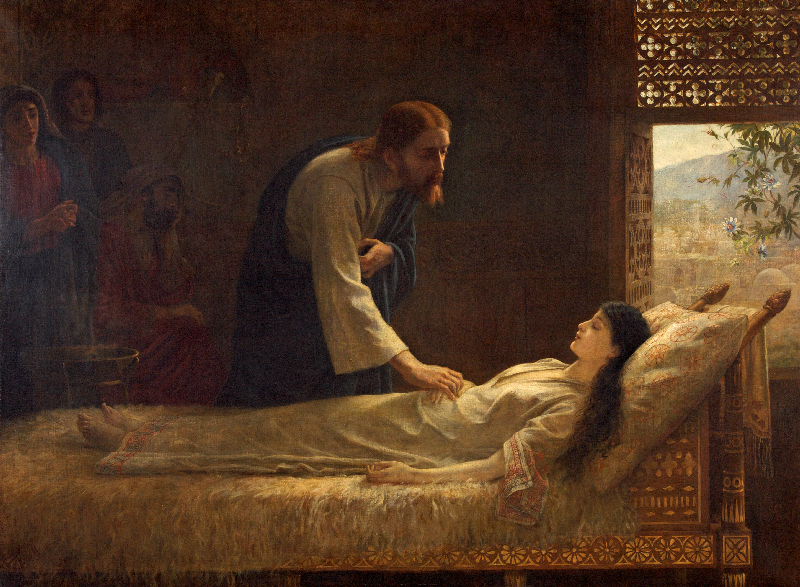
The Raising of Jairus' Daughter

Title: The Raising of Jairus' Daughter

Artist: Edwin Longsden Long

Medium: oil on canvas

Size: 163 x 183 cm

Date: 1889

Location: Victoria Art Gallery, Bath.


Mark 5:35-43: While Jesus was still speaking, some men came from the house of Jairus, the synagogue ruler. "Your daughter is dead," they said. "Why bother the teacher any more?" Ignoring what they said, Jesus told the synagogue ruler, "Don't be afraid; just believe." He did not let anyone follow him except Peter, James and John the brother of James. When they came to the home of the synagogue ruler, Jesus saw a commotion, with people crying and wailing loudly. He went in and said to them, "Why all this commotion and wailing? The child is not dead but asleep." But they laughed at him. After he put them all out, he took the child's father and mother and the disciples who were with him, and went in where the child was. He took her by the hand and said to her, "Talitha koum!" (which means, "Little girl, I say to you, get up!" ). Immediately the girl stood up and walked around (she was twelve years old). At this they were completely astonished. He gave strict orders not to let anyone know about this, and told them to give her something to eat.


The artist shows the most dramatic of moment of this passage, just before the girl comes back to life. Her parents and a disciple watch with anticipation as the miracle takes place. Jesus had sent the faithless outside, put them out, keeping only those who believed with him in the room. The window to the right of the picture, with a view of the city of Nazareth, is the primary source of light within the scene. But the reflection off the face of Jesus, most notably the illumination provided on his mouth and beard, make it seem as though the words ‘Talitha koum” are also a source of light.


Edwin Long (12 July 1829 – 15 May 1891) was an English genre, history, and portrait painter, born at Kelston, near Bath. After working locally as a portrait painter, he moved to London in the 1850s and became a very successful artist, painting Middle Eastern scenes populated with beautiful young women. Long was elected an associate of the Royal Academy in 1870 and an academician (RA) in 1881. Although he only painted a few Biblical pictures, religion was very important to Long. His parents had given him a religious upbringing; they were Congregationalist Dissenters and attended chapel regularly. Long never forgot his place of birth: in the 1880s he moved into an imposing house which he called Kelston.

Sunday, April 4, 2010

Ascension

Title: Ascension

Artist: Salvador Dali

Medium: Oil on canvas

Size: 115 x 123 cm

Date: 1958

Location: Private collection.


Mark 16:19-20 After the Lord Jesus had spoken to them, he was taken up into heaven and he sat at the right hand of God. Then the disciples went out and preached everywhere, and the Lord worked with them and confirmed his word by the signs that accompanied it.


Both Jewish and gentile readers could relate to the idea of an ascension of a great hero, but for Jesus to sit at God’s right hand goes beyond this idea – it means that Jesus reigns as God’s agent. Reference to this singular honor is found in Psalms 110:1, and its significance attested to again in the Letter to the Hebrews 1:13, when its author writes “To which of the angels did God ever say, ‘Sit at my right hand until I make your enemies a footstool for your feet’?”


Dali said that his inspiration for the theatrical ‘Ascension’ came from a "cosmic dream" that he had in 1950, some eight years before the painting was completed. In the dream, which was in vivid color, he saw the nucleus of an atom, which we see in the background of the painting. In this painting the focus is on the bottoms of the supine figure's feet, an homage to Mantegna's landmark ‘Dead Christ’,' an early and daring example of perspective. Vanishing-point perspective was the forerunner of Dali's own optical illusions.


Salvador Dali (1904 - 1989) was a Spanish Catalan surrealist painter, sculptor, graphic artist, and designer. He was born in the small town of Figueres, Spain. Dali was a skilled draftsman, best known for the striking and bizarre images in his surrealist work. His painterly skills are often attributed to the influence of Renaissance masters. Dali's name is synonymous with the Surrealist art movement. A prolific artist, Dali created more than 1500 paintings during his life time, as well many works in other media including prints, drawings, sculpture, book illustration, and theater set designs.


*


“The grace of God be with you all! Amen.” Heb 13:25

Saturday, April 3, 2010

Jesus Appears to the Disciples After the Resurrection

Title: Jesus Appears to the Disciples After the Resurrection
Artist: Imre Morocz
Medium: Oil on canvas on plywood
Size: 30 x 40cm
Date: 2009
Location: Private Collection

Mark 16:14-18 Later Jesus appeared to the Eleven as they were eating; he rebuked them for their lack of faith and their stubborn refusal to believe those who had seen him after he had risen.

He said to them, "Go into all the world and preach the good news to all creation. Whoever believes and is baptized will be saved, but whoever does not believe will be condemned. And these signs will accompany those who believe: In my name they will drive out demons; they will speak in new tongues; they will pick up snakes with their hands; and when they drink deadly poison, it will not hurt them at all; they will place their hands on sick people, and they will get well."

This passage, not part of the original Mark that consists of the material to end of Mark 16:8, is nonetheless used as a clear exhortation for evangelism, a direct command to “Go into all the world and preach the good news”.

The moment when Jesus finally appeared to the eleven is ethereally captured in this painting. A wash of warm light spills over the resurrected Christ. His assembled disciples gaze at his wound, kneel before him, and recognize at last what they had failed to see before.

Imre Morocz (b. 1967) is a contemporary portrait artist and landscape painter from Hungary. His paintings are an expression of his deep love of the Advaita school of Hindu philosophy, whereby everything is considered a part of a great Oneness. To view his own site and for links to other sites featuring more of his work, use the following link: http://www.paintingsilove.com/artist/imremorocz

Friday, April 2, 2010

Christ and his Disciples on the Road to Emmaus

Title: Landscape with Christ and his Disciples on the Road to Emmaus

Artist: Jan Wildens and Hans Jordaens III

Medium: Oil on canvas

Size: 123 x 168 cm

Date: C. 1640s

Location: The Hermitage, St. Petersburg.


Mark 16:12-13 Afterward Jesus appeared in a different form to two of them while they were walking in the country. These returned and reported it to the rest; but they did not believe them either.


He is said to have appeared to them in another form, perhaps in the form of a traveler, in another dress than what he usually wore. Regardless, these disciples should have recognized him, and in an event more fully related in Luke 24:16–31, when they finally shed their doubts, they knew him immediately. The rest also did not believe, and suspected that the others eyes had deceived them. The proofs of Christ’s resurrection were given gradually, cautiously, that so the assurance with which the apostles preached this doctrine afterward might be the more satisfying. That his staunchest followers were disbelieving at first, shows that afterward they did not believe it capriciously but rather with a full conviction.


Jan Wildens (Antwerp, c. 1596 – 16 October 1653) was a Flemish Baroque painter and draughtsman. He is best known for painting landscape backgrounds for Rubens and for many artists in his circle, but his finest independent work shows he was an accomplished master in his own right. The figures in this landscape were painted by Hans Jordaens III, another Antwerp artist. Jordaens (b. 1595 - 1643, Antwerp), who appears to have been fairly successful, trained with his father, Hans Jordaens II, who was also a painter. The younger Jordaens was responsible for finishing works by Abraham Govaerts after the latter's death in 1626.

Thursday, April 1, 2010

Mary Magdalene Announcing the Resurrection to the Apostles

Title: Mary Magdalene Announcing the Resurrection to the Apostles

Artist: Unknown

Medium: Illumination on parchment

Size: 18 x 14 cm

Date: c. 1123

Location: St. Albans Psalter, St Godehard's Church, Hildesheim.


Mark 16:10-11 She went and told those who had been with him and who were mourning and weeping. When they heard that Jesus was alive and that she had seen him, they did not believe it.


Yet again, the disciples are unable to grasp the magnitude of what has occurred. Despite Jesus having told them on a number of occasions that he would be raised from the dead (e.g. Mark 9:9-10), they refused to believe what Mary Magdalene had to report.


The St Albans Psalter, also known as the Albani Psalter or the Psalter of Christina of Markyate, is an English illuminated manuscript, one of several Psalters known to have been created at or for St Albans Abbey in the 12th century. It is widely considered to be one of the most important examples of English Romanesque book production. The almost unprecedented lavishness of decoration contains a number of iconographic innovations that would endure throughout the Middle Ages.


The main artist decorating the St Albans Psalter is called the ‘Alexis Master’ after a section of the work which contains the biography of a fifth-century Roman saint called Alexis. The Alexis Master is credited with introducing a new figurative and narrative style into English art in the 1120s. This new style was much indebted to eleventh-century German and early twelfth-century Italo-Byzantine style.

Wednesday, March 31, 2010

The Appearance of Christ to Mary Magdalene

Title: The Appearance of Christ to Mary Magdalene

Artist: Alexander Ivanov

Medium: Oil on canvas

Size: tdb.

Date: 1835

Location: The State Russian Museum, St. Petersburg.


Mark 16:9 When Jesus rose early on the first day of the week, he appeared first to Mary Magdalene, out of whom he had driven seven demons.


Most biblical scholars agree that the original writer of the Gospel of Mark did not write the verses that follow 16:8, and the question arises as to whether that verse was the original ending of the Gospel. That idea has always seemed to make readers uneasy, and in antiquity there were several attempts to graft an ending onto Mark (16:9-20). These spurious endings offer the reader a choice: did the writer mean for the Gospel to end at 16:8, or was there an original ending that was somehow lost? Some scholars have proposed that the Gospel of John, chapter 21, contains most of the elements that were originally found in Mark. There is also evidence that Luke knew the original Mark complete with the material found in John 21, as Luke 5:3-10 merged Mark's story of how Jesus met Peter with a tale of a miraculous catch of fish found in John.


Ivanov’s ‘The Appearance of Christ to Mary Magdalene’ was warmly welcomed in St Petersburg and won him the title of Academician. The artist himself, however, was not entirely happy with the painting and it’s formal theatricality, reportedly referring to it as merely "corn-cob." Yet in his fascinating preparatory drawings for it, he conveyed the figures in a freer and more natural manner.


Alexander Andreyevich Ivanov (July 28, 1806 – July 15, 1858) was a Russian painter. His father, Andrey Ivanov, was an artist, the professor of the Academy of Arts, and it was his father who first taught Alexander art. Beginning around 1833, and throughout the next twenty years of his life, Ivanov consistently pondered over the theme of his masterpiece ‘The Appearance of Christ to the People’. This huge painting became, with time, synonymous with Ivanov's entire career. In 1858 Ivanov returned to St Petersburg and died two months later. His tremendous influence on Russian art can hardly be assessed in a few words. He undoubtedly ranks among the major Russian artists of the first half of the nineteenth century. His paintings, studies and drawings are a priceless part of the classical heritage.

Tuesday, March 30, 2010

The Two Marys at the Tomb

Title: The Two Marys at the Tomb

Artist: Bartolomeo Schedoni

Medium: Oil on canvas

Size: tbd.

Date: 1613

Location: Galleria Nazionale, Parma.


Mark 16:6-8 "Don't be alarmed," he said. "You are looking for Jesus the Nazarene, who was crucified. He has risen! He is not here. See the place where they laid him. But go, tell his disciples and Peter, 'He is going ahead of you into Galilee. There you will see him, just as he told you.' "


Trembling and bewildered, the women went out and fled from the tomb. They said nothing to anyone, because they were afraid.


Throughout Mark, people spread news that they were supposed to keep quiet; here, when Mary Magdalene, Mary the mother of James, and Salome are finally commanded to spread the word, they keep quiet. Again, the Gospel displays and ironic twist.


This memorable masterpiece, The Two Marys at the Tomb, gives us cause to regret the brevity of Bartolomeo Schedoni's tormented artistic life. It shows that he really would have been able to point Baroque painting in an original and intense direction. The way he blocked out gestures, used violent light and dazzling whites, combined with perfect clarity of detail to produce an almost metaphysical effect.


Bartolomeo Schedoni (1578-1615) was an Italian early Baroque painter and an eccentric exponent of the Emilian school. Schedoni went to Rome at the close of the sixteenth century, but he soon returned to Emilia and settled in Parma. It was there that he painted a small but fascinating group of masterpieces in a severe and noble style. At the same time his works were warmed by a light that softened fabrics and added delicacy to expressions. His untimely death (perhaps suicide owing to gambling debts) brought an abrupt end to the career of one of the most attractive painters of the seventeenth century.

Monday, March 29, 2010

The Holy Women at the Sepulcher

Title: Le Saintes Femmes au Tombeau (The Holy Women at the Sepulcher)

Artist: William-Adolphe Bouguereau

Medium: Oil on Canvas

Size: tbd

Date: 1890

Location: Private Collection


Mark 16: 4-5 But when they looked up, they saw that the stone, which was very large, had been rolled away. As they entered the tomb, they saw a young man dressed in a white robe sitting on the right side, and they were alarmed.


This painting by Bouguereau has an immediacy and vividness, an seems to have been influenced by photography. The young man in white, only just visible in the light that comes from the tomb, at first seems largely redundant. The first and third women are also well composed, but all the meaning and power of the picture is focused in the central figure, on her astonished face and her clasped hands. But the composition invites us to look beyond just the surface image. We can see a fourth place left available to stand among the women, to peer into the tomb, to see what the three women see. There is a place for us to bear witness if we are willing to take the step forward.


William-Adolphe Bouguereau (November 30, 1825 - August 19, 1905) was a French academic painter. Bouguereau was a staunch traditionalist whose realistic genre paintings and mythological themes were modern interpretations of Classical subjects. Toward the end of his career, at the same time that he was admired by the public, he was also impugned by a growing clique of painters and writers of the new generation who considered themselves progressive, and who believed that rebellion against traditional values in painting was their raison d'etre. Bouguereau and his colleagues were rapidly labeled as reactionaries in the face of this growing cult of the new, found first in Impressionism and Post Impressionism. His fate was to be much like that of Rembrandt, whose work was also ridiculed and banished from museums and official art circles for the hundred years following his death.