Showing posts with label Jairus. Show all posts

Tuesday, August 2, 2011

19 IMAGES FROM THE 19th CENTURY: PART 15 - The Raising of the Daughter of Jairus

Title: The Raising of the Daughter of Jairus
Artist: Gabriel Max
Medium: Oil on Canvas
Size: 71.9 x 87.9 cm
Date: 1881
Location: The Walters Art Museum, Baltimore.

19 IMAGES FROM THE 19th CENTURY: PART 15

Luke 8:51-56 When he arrived at the house of Jairus, he did not let anyone go in with him except Peter, John and James, and the child’s father and mother. Meanwhile, all the people were wailing and mourning for her. “Stop wailing,” Jesus said. “She is not dead but asleep.” They laughed at him, knowing that she was dead. But he took her by the hand and said, “My child, get up!” Her spirit returned, and at once she stood up. Then Jesus told them to give her something to eat. Her parents were astonished, but he ordered them not to tell anyone what had happened.

The model for Christ has been identified as Joseph Mair, who played the role of the Lord in the famous Oberammergau Passion Play, and the artist’s first wife, Emma Kitzinger, is thought to have posed for the daughter of Jairus. Although favoring the dark tones of his teacher Karl Theodor von Piloty, Max shows his own tendency to add light, delicate tones where applicable. Here, the daughter of Jairus glows with a renewed life, as though the power of Jesus has flowed from his darkened figure, and poured into her. Her expression appears almost bewildered as she rises up from her resting place.

Gabriel Cornelius Ritter von Max (August 1840 – November 1915) was born in Prague, then part of the Austro-Hungarian Empire. He studied between 1855 and 1858 at the Prague Academy of Arts with Eduard von Engerth. From 1863 to 1867 he studied at the Munich Academy with Karl Theodor von Piloty, and also Hans Makart and Franz Defregger. His first critical success was in 1867 with the painting "Martyr at the Cross": that painting transformed the dark palette of Piloty into a religious-mystical symbolism using a psychological rendering of its subject. He continued to use the dark palette of the Piloty school well into the 1870s, later moving toward a more muted palette, using fewer, clearer colors.

Wednesday, August 11, 2010

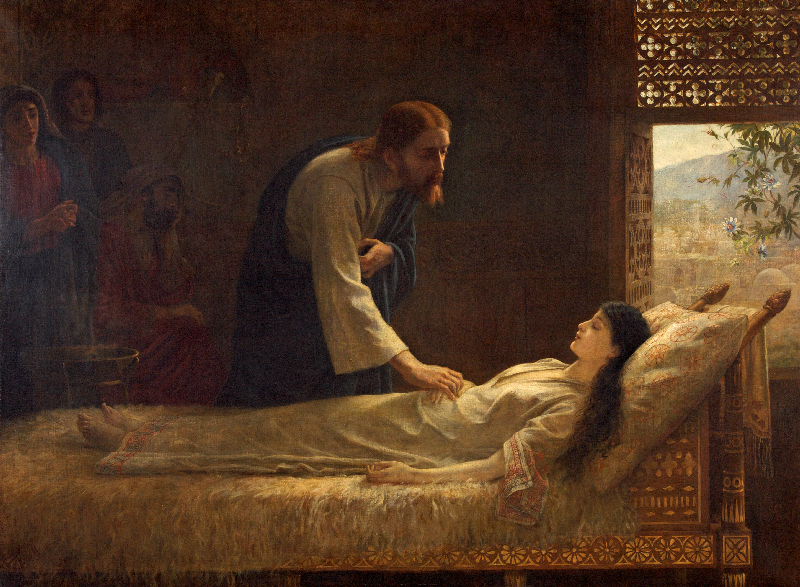
The Raising of Jairus' Daughter

Title: The Raising of Jairus' Daughter

Artist: Edwin Longsden Long

Medium: oil on canvas

Size: 163 x 183 cm

Date: 1889

Location: Victoria Art Gallery, Bath.


Mark 5:35-43: While Jesus was still speaking, some men came from the house of Jairus, the synagogue ruler. "Your daughter is dead," they said. "Why bother the teacher any more?" Ignoring what they said, Jesus told the synagogue ruler, "Don't be afraid; just believe." He did not let anyone follow him except Peter, James and John the brother of James. When they came to the home of the synagogue ruler, Jesus saw a commotion, with people crying and wailing loudly. He went in and said to them, "Why all this commotion and wailing? The child is not dead but asleep." But they laughed at him. After he put them all out, he took the child's father and mother and the disciples who were with him, and went in where the child was. He took her by the hand and said to her, "Talitha koum!" (which means, "Little girl, I say to you, get up!" ). Immediately the girl stood up and walked around (she was twelve years old). At this they were completely astonished. He gave strict orders not to let anyone know about this, and told them to give her something to eat.


The artist shows the most dramatic of moment of this passage, just before the girl comes back to life. Her parents and a disciple watch with anticipation as the miracle takes place. Jesus had sent the faithless outside, put them out, keeping only those who believed with him in the room. The window to the right of the picture, with a view of the city of Nazareth, is the primary source of light within the scene. But the reflection off the face of Jesus, most notably the illumination provided on his mouth and beard, make it seem as though the words ‘Talitha koum” are also a source of light.


Edwin Long (12 July 1829 – 15 May 1891) was an English genre, history, and portrait painter, born at Kelston, near Bath. After working locally as a portrait painter, he moved to London in the 1850s and became a very successful artist, painting Middle Eastern scenes populated with beautiful young women. Long was elected an associate of the Royal Academy in 1870 and an academician (RA) in 1881. Although he only painted a few Biblical pictures, religion was very important to Long. His parents had given him a religious upbringing; they were Congregationalist Dissenters and attended chapel regularly. Long never forgot his place of birth: in the 1880s he moved into an imposing house which he called Kelston.